The Stair Calculator is an online tool for calculating various parameters involved in the construction of stairs. Refer to the figure adjacent to the calculator as a reference. A fraction-to-decimal conversion table for common fractions used in measurements is also provided at the bottom of the page.
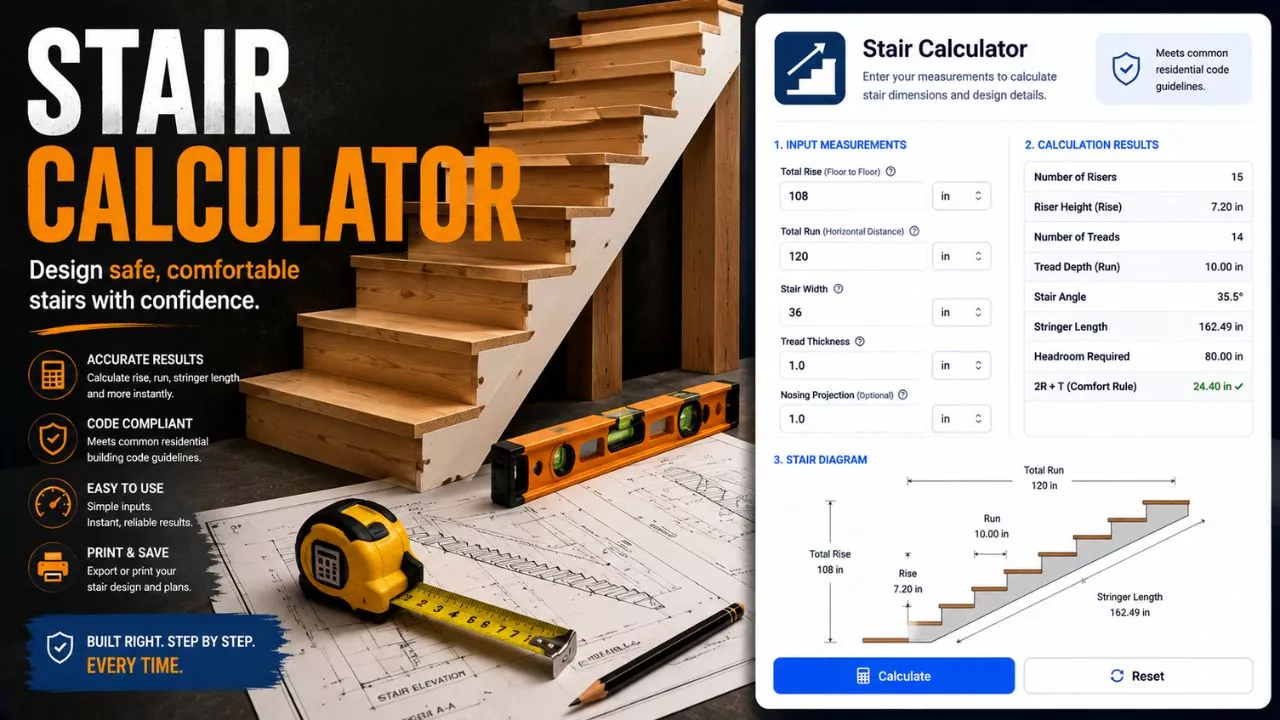
A stair calculator is a simple but powerful tool that helps you design safe and comfortable stairs. Whether you are building stairs for your home, a deck, or even a small project, getting the measurements right is very important. Poorly designed stairs can feel awkward to use and may even be unsafe. That is why a stair calculator is so helpful. It takes basic measurements and turns them into a step-by-step plan.
In the United States, building stairs often needs to follow certain building codes. These rules make sure that stairs are safe and easy to use for everyone. A stair calculator helps you stay within these rules by suggesting the right height and depth for each step. Instead of guessing or doing complicated math, you can simply enter a few numbers and get accurate results.
Many people think stair design is only for professionals, but that is not true. With the help of a stair calculator, anyone can understand how stairs work. It breaks down the process into simple parts and shows you how each measurement affects the final design. This makes it easier to plan your project with confidence.
You will learn what a stair calculator is, how it works, why it is useful, and how you can use it for your own projects. By the end, you will have a clear idea of how to design stairs that are both safe and comfortable.
What Is a Stair Calculator?
A stair calculator is a digital tool that helps you figure out the correct dimensions for a staircase. It uses a few basic inputs, such as the total height from one floor to another and the length of space available for the stairs. Based on this information, it calculates the number of steps, the height of each step, and the depth of each tread.
The height of each step is called the riser, and the flat part where you place your foot is called the tread. These two parts must be balanced properly. If the riser is too high, climbing the stairs becomes tiring. If the tread is too short, it can feel unsafe. A stair calculator ensures that both measurements are comfortable and meet standard guidelines.
In the United States, building codes usually recommend a riser height of about 7 to 7.75 inches and a tread depth of at least 10 inches. A stair calculator automatically keeps your design within these ranges. This is helpful because you do not have to memorize the rules or worry about making mistakes.
Another useful feature of stair calculators is that they can adjust your design if your inputs are not ideal. For example, if your available space is too small, the calculator may suggest changing the number of steps or slightly adjusting the dimensions. This flexibility helps you find a practical solution without starting from scratch.
Overall, a stair calculator simplifies the entire process of stair design and makes it accessible for anyone.
How a Stair Calculator Works?
A stair calculator works by using simple math to turn your measurements into a complete stair design. You start by entering the total rise, which is the vertical distance from the lower floor to the upper floor. Then you enter the total run, which is the horizontal space available for the stairs.
Once you provide these values, the calculator divides the total rise into equal parts to determine the number of steps. For example, if the total rise is 105 inches and each step is about 7 inches high, the calculator will suggest around 15 steps. It will then adjust the exact height of each riser to make sure all steps are equal.
Next, the calculator looks at the total run and divides it by the number of steps to find the tread depth. This ensures that each step has enough space for your foot. The goal is to create a smooth walking experience where each step feels natural.
Many stair calculators also follow a common rule used in stair design, where the riser height and tread depth work together. A popular guideline is that twice the riser height plus the tread depth should be close to 24 to 25 inches. This helps create a comfortable rhythm when walking up or down the stairs.
Some advanced calculators also provide diagrams or visual layouts. These visuals make it easier to understand how your staircase will look once built. By using these tools, you can quickly test different designs and choose the one that works best for your space.
Why Stair Calculators Are Important?
Stair calculators are important because they help prevent mistakes that can lead to unsafe or uncomfortable stairs. Building stairs without proper planning can result in uneven steps, which can cause trips and falls. Even a small difference in step height can make stairs difficult to use.
Safety is one of the biggest reasons to use a stair calculator. In the United States, building codes exist to protect people from accidents. A stair calculator helps ensure your design follows these rules. This is especially important if you are building stairs for a home that will be inspected or sold in the future.
Comfort is another key factor. Stairs should feel natural when you walk on them. If the steps are too steep, you may feel tired quickly. If they are too shallow, you may feel like you are taking tiny steps. A stair calculator balances these measurements so that the stairs are easy to use for people of all ages.
Using a stair calculator also saves time and effort. Instead of doing calculations by hand, you can get accurate results in seconds. This allows you to focus more on the design and construction process rather than worrying about math.
In addition, stair calculators help reduce material waste. When your measurements are accurate, you can plan your cuts and materials more efficiently. This not only saves money but also makes your project more environmentally friendly.
Key Measurements in Stair Design
Understanding the key measurements in stair design is essential when using a stair calculator. Each measurement plays a specific role in how the stairs look and feel.
The total rise is the vertical distance between two levels. This is the starting point for any stair design. The total run is the horizontal distance the stairs will cover. Together, these two values define the overall size of the staircase.
The riser height is the vertical height of each step. It is important that all risers are equal to prevent uneven steps. The tread depth is the horizontal surface where you place your foot. A deeper tread provides more stability, while a shallower tread may feel less secure.
Another important measurement is the stair angle. This is the slope of the staircase. A steep angle means the stairs take up less space but are harder to climb. A gentler angle is more comfortable but requires more room.
Headroom is also a key factor. This is the space above the stairs that allows people to walk without hitting their head. Building codes in the United States usually require a minimum headroom of about 6 feet 8 inches.
Finally, there is the width of the stairs. Wider stairs are easier to use and allow more than one person to move at the same time. While the minimum width may vary, many homes use a width of at least 36 inches.
By understanding these measurements, you can use a stair calculator more effectively and create a well-designed staircase.
Types of Stairs You Can Design
A stair calculator can be used for many different types of stairs. Each type has its own style and purpose, but the basic calculations remain similar.
Straight stairs are the most common type. They go in one direction without any turns. These are the easiest to design and build, making them a popular choice for homes.
L-shaped stairs include a turn, usually at a right angle. This design is useful when you want to save space or add a visual element to your home. A stair calculator can help you adjust the measurements for the landing area where the turn occurs.
U-shaped stairs have two parallel flights with a landing in between. These are often used in larger homes or buildings. They take up more space but can be more comfortable to use.
Spiral stairs are compact and stylish. They are often used in small spaces or as a secondary staircase. While they look unique, they require careful planning because the steps are narrower on one side.
Curved stairs are similar to spiral stairs but have a larger radius and a smoother curve. These are more complex and often used in high-end designs.
No matter the type, a stair calculator helps ensure that each design meets safety and comfort standards. It allows you to experiment with different layouts and find the best option for your space.
How to Use a Stair Calculator Step by Step
Using a stair calculator is simple once you understand the basic steps.
First, measure the total rise. This is the distance from the floor at the bottom to the floor at the top. Be as accurate as possible because even small errors can affect the final design.
Next, measure the total run. This is the amount of horizontal space you have for the staircase. If your space is limited, you may need to adjust your design to fit.
Enter these values into the stair calculator. The tool will then suggest the number of steps, the riser height, and the tread depth. Review these results carefully to make sure they meet your needs.
If the suggested design does not fit your space or preferences, you can adjust the inputs. For example, you can try a different number of steps or slightly change the dimensions. The calculator will update the results instantly.
After finalizing the measurements, check that your design follows local building codes. Many stair calculators already consider these rules, but it is always a good idea to double-check.
Finally, use the results to plan your construction. Mark the measurements clearly and ensure that each step is consistent. With careful planning and the help of a stair calculator, you can build a staircase that is both safe and comfortable.