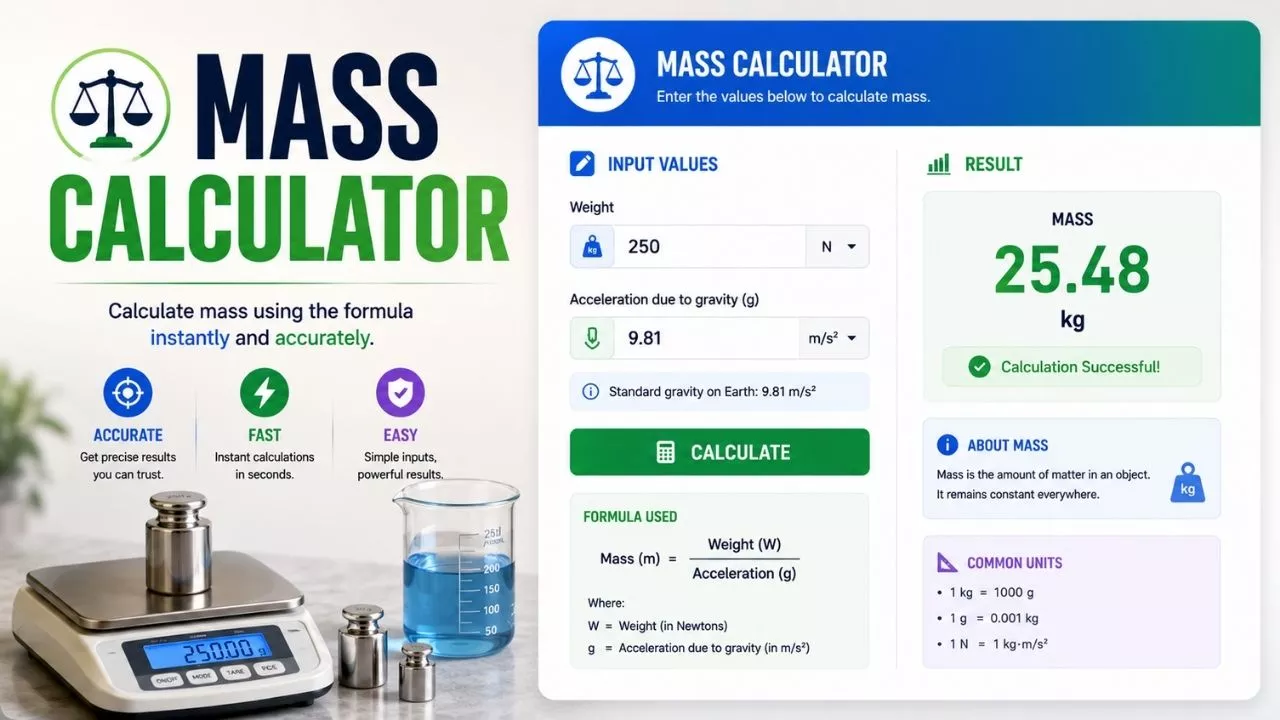
Mass is one of the most basic ideas in science, yet it plays a huge role in everyday life. Whether you are cooking, shopping, building something, or studying physics, understanding mass helps you make better decisions.
A mass calculator is a tool that makes this easier. It helps you quickly find the mass of an object using simple inputs like volume and density or by converting between units.
A mass calculator is not just for scientists or engineers. It is useful for students, teachers, hobbyists, and even professionals in fields like construction, shipping, and manufacturing. Instead of doing calculations by hand, you can use a calculator to get accurate results in seconds. This saves time and reduces mistakes.
In this blog, you will learn what mass is, how a mass calculator works, when to use it, and why it is important. Each section will explain concepts step by step in a way that is easy to follow. By the end, you will feel more confident using a mass calculator and understanding the numbers it gives you.
What Is Mass and Why It Matters
Mass is the amount of matter in an object. In simple terms, it tells you how much “stuff” something is made of. For example, a bowling ball has more mass than a tennis ball because it contains more material. Mass is usually measured in grams, kilograms, or pounds in the United States.
Mass is different from weight, even though people often mix them up. Weight depends on gravity, while mass does not change. If you take an object to the moon, its weight will be less, but its mass will stay the same.
This is important in science because mass is a constant value that helps us understand how objects behave.
Mass matters in many real-life situations. When cooking, you need the right mass of ingredients to get the best results. In construction, materials must have the correct mass to ensure safety and stability. In shipping, companies calculate costs based on the mass of packages.
Understanding mass also helps in learning other scientific concepts like force and energy. For example, heavier objects require more force to move.
This is why pushing a car is harder than pushing a bicycle. A mass calculator helps you find these values quickly so you can focus on solving problems instead of doing long calculations.
What Is a Mass Calculator
A mass calculator is a tool that helps you determine the mass of an object using known values. It can be a physical calculator, an online tool, or part of a mobile app. Most commonly, it uses the relationship between mass, density, and volume.
The main formula used is:
This means if you know how dense a material is and how much space it takes up, you can calculate its mass. For example, if you know the density of water and the volume of a container, you can easily find the mass of the water inside it.
Mass calculators often allow you to input different units. You might enter volume in liters or cubic meters and density in grams per cubic centimeter. The calculator then converts everything into the correct units and gives you the result.
Some advanced mass calculators can also work in reverse. If you know mass and density, they can help you find volume. This makes them very flexible tools for different types of problems.
Using a mass calculator is simple. You enter the known values, select the correct units, and press calculate. The result appears instantly, which makes it much faster than solving equations manually. This convenience is one of the main reasons why mass calculators are widely used today.
How a Mass Calculator Works
A mass calculator works by applying basic scientific formulas and unit conversions behind the scenes. Even though it may look simple on the outside, it performs several steps to ensure accuracy.
First, the calculator takes the values you input, such as density and volume. It checks the units you selected and converts them into a standard format if needed.
This is important because calculations must use consistent units. For example, if density is given in kilograms per cubic meter and volume is in liters, the calculator adjusts them to match.
Next, it uses the formula:
Here, m stands for mass, represents density, and is volume. The calculator multiplies density by volume to find the mass.
After performing the calculation, the tool converts the result into the unit you prefer. You might see the answer in grams, kilograms, or pounds depending on your choice. This flexibility makes the calculator useful in different regions and industries.
For example, imagine you have a metal block with a density of 7.8 grams per cubic centimeter and a volume of 10 cubic centimeters. The calculator multiplies these values and gives a mass of 78 grams.
The entire process takes less than a second, but it involves precise mathematical steps. This is why mass calculators are reliable and widely trusted tools for both learning and practical use.
Different Types of Mass Calculations
Mass calculators can handle several types of calculations depending on what information you have. Understanding these types helps you choose the right approach for your problem.
The most common type is calculating mass using density and volume. This is used in science experiments, engineering projects, and everyday tasks like measuring liquids or materials.
Another type involves converting mass units. For example, you might need to convert pounds to kilograms or grams to ounces. This is especially useful in the United States, where both metric and imperial units are commonly used.
Some calculators also help find density instead of mass. If you know the mass and volume, you can rearrange the formula:
This is useful in identifying materials. Different substances have unique densities, so calculating density can help determine what something is made of.
There are also calculators designed for specific materials like metals, liquids, or gases. These tools often include preset density values, so you do not have to look them up manually. For example, if you select aluminum, the calculator automatically uses its standard density.
Each type of calculation serves a different purpose, but they all rely on the same basic principles. This makes mass calculators versatile tools that can handle a wide range of problems efficiently.
Real Life Uses of a Mass Calculator
Mass calculators are used in many real life situations, often without people realizing it. They help make tasks easier, faster, and more accurate.
In the kitchen, mass calculators can help with recipes that require precise measurements. For example, if a recipe calls for a certain volume of an ingredient, you can use its density to find the exact mass needed. This is especially helpful in baking, where accuracy matters a lot.
In shipping and logistics, companies use mass to determine shipping costs. Packages are weighed, and the mass is used to calculate fees. A mass calculator can help estimate these costs before sending items.
In construction, workers need to know the mass of materials like concrete, steel, and wood. This helps ensure that structures are safe and can support the required loads. Engineers rely on accurate mass calculations when designing buildings and bridges.
Students also use mass calculators in science classes. They help solve problems quickly and allow students to focus on understanding concepts instead of getting stuck on math.
For example, if you are filling a fish tank and want to know how heavy the water will be, a mass calculator can give you the answer instantly. This helps you decide where to place the tank safely.
These examples show how useful mass calculators are in both simple and complex situations.
Common Mistakes and How to Avoid Them
While mass calculators are easy to use, people can still make mistakes if they are not careful. Understanding these common errors can help you get more accurate results.
One common mistake is using the wrong units. If you enter volume in liters but density in grams per cubic centimeter, the result may be incorrect unless the calculator adjusts for it. Always double check that your units match or that the calculator handles conversions automatically.
Another mistake is entering incorrect values. Even a small error in density or volume can lead to a big difference in the final result. It is important to use reliable data and measure carefully.
People also sometimes confuse mass with weight. Remember that mass is measured in units like grams or kilograms, while weight is measured in newtons or pounds as a force. Using the wrong concept can lead to confusion.
Rounding numbers too early is another issue. If you round values before completing the calculation, your final answer may not be accurate. It is better to keep full precision until the end.
Finally, some users rely completely on the calculator without understanding the formula. While the tool is helpful, knowing how it works allows you to catch errors and make better decisions.
By avoiding these mistakes, you can use a mass calculator more effectively and trust the results you get.
Tips for Using a Mass Calculator Effectively
Using a mass calculator is simple, but a few tips can help you get the best results and avoid confusion.
Start by clearly identifying what you are trying to find. Are you solving for mass, volume, or density? Knowing this will help you choose the correct inputs and formula.
Always check your units before entering values. Make sure they are consistent or that the calculator can convert them properly. This step can save you from incorrect answers.
Use accurate data whenever possible. If you are working with materials, look up their correct density values from reliable sources. Small differences in density can affect your results.
Take advantage of built in features. Many mass calculators include unit converters and preset material densities. These tools can make your work faster and more precise.
Practice with simple examples first. For instance, try calculating the mass of water in a one liter bottle. Since the density of water is about 1 gram per cubic centimeter, the result should be close to 1000 grams or 1 kilogram. This helps you understand how the calculator works.
Finally, double check your results. Even though calculators are accurate, reviewing your inputs and outputs ensures everything makes sense.
With these tips, you can use a mass calculator confidently in school, work, and everyday life.