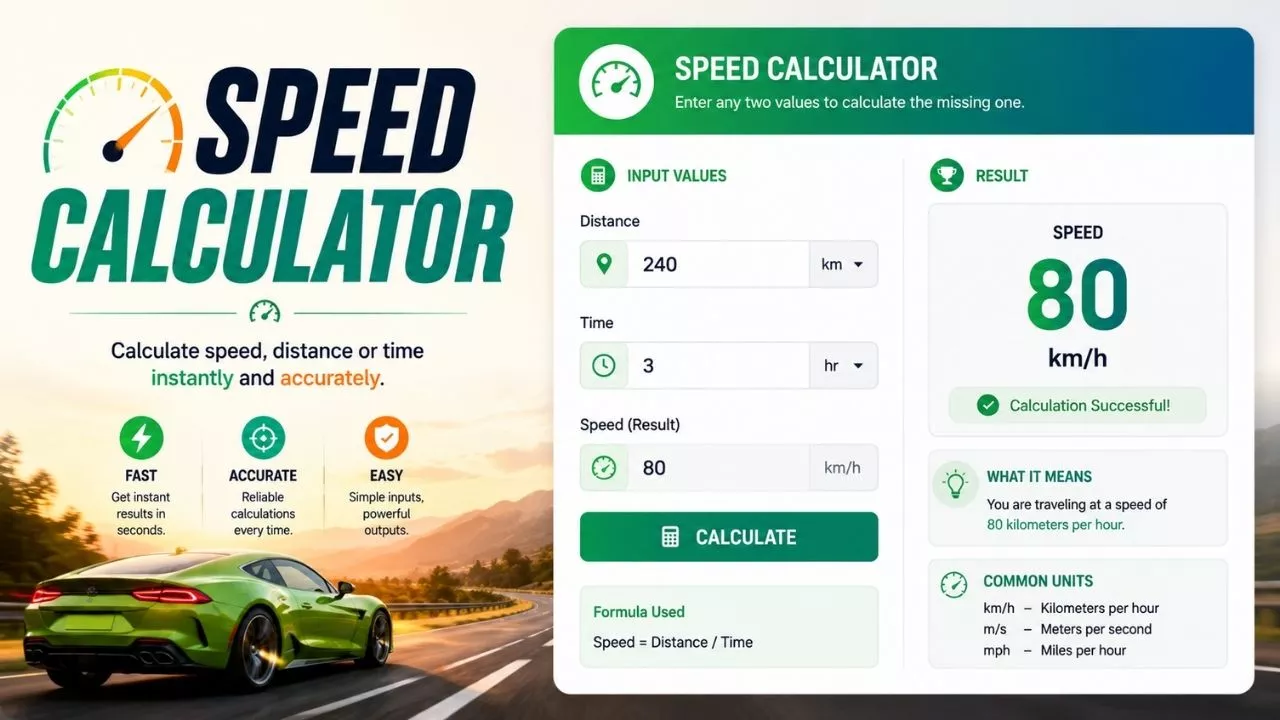
This speed calculator is a tool that helps you determine the average speed of a moving object based on the distance traveled over a certain time traveled. Whether you are test-driving your brand-new car or just going for a quick jog or cycle, if you want to know how to find average speed, this calculator will come in handy.
Speed is something we experience every day, whether we are walking to school, riding a bike, or traveling in a car. A speed calculator is a simple tool that helps us understand how fast something is moving. It connects three important ideas: distance, time, and speed. Once you understand how these work together, you can solve many real-life problems with ease.
What Is Speed?
Speed tells us how fast something moves from one place to another. It is measured by how much distance is covered over a certain amount of time. For example, if a car travels 60 miles in one hour, its speed is 60 miles per hour.
In simple terms, speed answers the question: how fast? It does not care about direction, only how quickly something moves. That is what makes it different from velocity, which includes direction as well.
A speed calculator helps you find speed when you know the distance and time. It saves you from doing manual calculations and reduces mistakes. This is especially helpful when working with large numbers or different units.
In the United States, speed is often measured in miles per hour, also written as mph. In science, you might also see meters per second. Both are correct, depending on the situation.
Understanding speed is useful in many areas of life. Drivers use it to follow speed limits, athletes use it to track performance, and scientists use it to study motion. Once you learn the basics, you will start noticing speed everywhere around you.
The Basic Speed Formula
The relationship between speed, distance, and time can be written as a simple formula:
This means you divide the distance traveled by the time it took to travel that distance. For example, if you walk 3 miles in 1 hour, your speed is:
This formula can also be rearranged depending on what you want to find. If you need to calculate distance, you can use:
If you want to find time, use:
These formulas are the foundation of any speed calculator. The calculator simply uses these relationships to give you quick answers.
It is important to make sure your units match before using the formula. For example, if distance is in miles, time should be in hours. If they do not match, you may get the wrong result.
Learning these formulas helps you understand how a speed calculator works behind the scenes. Instead of just pressing buttons, you know exactly what is happening, which builds confidence and improves problem-solving skills.
How a Speed Calculator Works
A speed calculator is designed to make calculations faster and easier. Instead of solving equations by hand, you simply enter the values you know, and the calculator does the rest.
Most speed calculators have three main input fields: distance, time, and speed. You enter any two values, and the calculator finds the third one using the correct formula.
For example, if you enter a distance of 120 miles and a time of 2 hours, the calculator will compute the speed as 60 miles per hour. It does this instantly, without requiring any manual steps.
Some advanced calculators also allow you to choose different units. You can switch between miles, kilometers, meters, hours, minutes, and seconds. This makes it easier to work with different types of problems.
Another useful feature is automatic unit conversion. If you enter distance in miles and time in minutes, the calculator can convert the units so the final answer makes sense.
Speed calculators are used in many fields, including transportation, sports, and science. They are also helpful for students who are learning about motion and need quick answers for homework or projects.
Even though calculators are helpful, it is still important to understand the concept. Knowing how to calculate speed on your own helps you check answers and avoid mistakes.
Real Life Examples of Speed
Speed is not just a classroom concept. It plays a role in many everyday situations. For example, when you drive on a highway, you see speed limit signs like 65 mph. These limits help keep everyone safe.
If you are planning a road trip, you can use speed to estimate how long it will take to reach your destination. Suppose you are traveling 180 miles at an average speed of 60 mph. You can calculate the time as:
hours
Athletes also use speed to measure performance. A runner might track how fast they complete a mile, while a swimmer measures how quickly they finish a lap.
In sports like baseball, speed is used to measure how fast a pitch is thrown. In track and field, it helps compare athletes and improve training.
Even in daily routines, speed matters. Walking speed, cycling speed, and even internet speed affect how we live and work.
Understanding speed helps you make better decisions. For example, if you are running late, you can estimate whether increasing your speed will help you arrive on time or not.
Units of Speed
Speed can be measured in different units depending on the situation. In the United States, the most common unit is miles per hour. This is used for cars, buses, and other vehicles.
In scientific studies, speed is often measured in meters per second. This unit is part of the metric system and is widely used around the world.
Other units include kilometers per hour, feet per second, and even knots, which are used in aviation and marine travel.
When using a speed calculator, it is important to understand these units and convert them when needed. For example, 1 mile per hour is equal to about 0.447 meters per second.
Unit conversion can seem tricky at first, but calculators make it easier. Many tools automatically handle conversions so you can focus on solving the problem.
Using the correct unit is important because it ensures accurate results. If you mix units without converting them, your answer will not make sense.
Learning about units also helps you understand global differences. While the United States uses miles, many other countries use kilometers. Knowing both makes you more flexible and knowledgeable.
Common Mistakes to Avoid
When using a speed calculator or solving problems manually, there are a few common mistakes to watch out for. One of the biggest mistakes is mixing units. For example, using miles for distance and minutes for time without converting them properly.
Another mistake is entering incorrect values. Even a small typing error can lead to a completely wrong answer. Always double-check your inputs before calculating.
Some people also forget to rearrange the formula correctly when solving for distance or time. Using the wrong formula can give misleading results.
Rounding errors can also affect accuracy. If you round numbers too early, your final answer may not be precise. It is better to round only at the end.
Another issue is misunderstanding what speed represents. Speed does not include direction, so it cannot tell you where something is going, only how fast it is moving.
To avoid these mistakes, take your time and understand each step. Even when using a calculator, it helps to think about whether the answer makes sense.
Practice is the best way to improve. The more problems you solve, the more confident you will become in using speed calculations correctly.
Benefits of Using a Speed Calculator
A speed calculator offers several advantages, especially for students and everyday users. It saves time by providing instant results, which is helpful when working on assignments or planning activities.
It also reduces the chance of errors. Manual calculations can sometimes lead to mistakes, especially with large numbers or complex conversions. A calculator handles these tasks accurately.
Another benefit is convenience. You can use a speed calculator on your phone, computer, or tablet anytime you need it. This makes it a practical tool for both learning and real-life situations.
Speed calculators also support learning. By comparing your manual answers with calculator results, you can check your understanding and improve your skills.
They are also useful for professionals. Engineers, drivers, athletes, and scientists all rely on speed calculations in their work.
In addition, many calculators include extra features like unit conversion and multiple input options. These features make them more flexible and easier to use.
Overall, a speed calculator is a helpful tool that combines simplicity with accuracy. It allows you to focus on understanding the concept rather than worrying about complex calculations.
Final Thoughts on Speed Calculation
Speed is a basic but powerful concept that connects distance and time. Once you understand how these elements work together, you can solve a wide range of problems.
A speed calculator makes this process easier by providing quick and accurate results. Whether you are studying, traveling, or analyzing performance, it is a useful tool to have.
By learning the formulas, understanding units, and practicing real life examples, you can build strong problem solving skills. These skills are valuable not only in school but also in everyday life.
Speed is all around us, from the movement of vehicles to the pace of our daily routines. Understanding it helps you see the world in a more informed and practical way.
With the help of a speed calculator, you can turn simple numbers into meaningful insights and make better decisions in your daily activities.