Molarity is one of the simplest ways to describe how strong a liquid mixture is, and a molarity calculator makes the math much easier. It helps you find how much substance is dissolved in a solution by using the amount of solute and the total volume of the liquid.
What Molarity Means?
Think of a solution as a drink mix. The powder or substance you add is the solute, and the liquid it is mixed into is the solvent. When both are combined, you get a solution, and molarity tells you how concentrated that solution is.
The standard molarity formula is, where is the molarity, is the number of moles of solute, and is the volume of the solution in liters. This means that if you know how many moles you have and how many liters of solution there are, you can find the molarity quickly.
A 1 molar solution means there is 1 mole of solute in 1 liter of solution. That idea is useful in labs, classrooms, and many chemistry tasks because it gives a common way to measure concentration.
Why a Calculator Helps
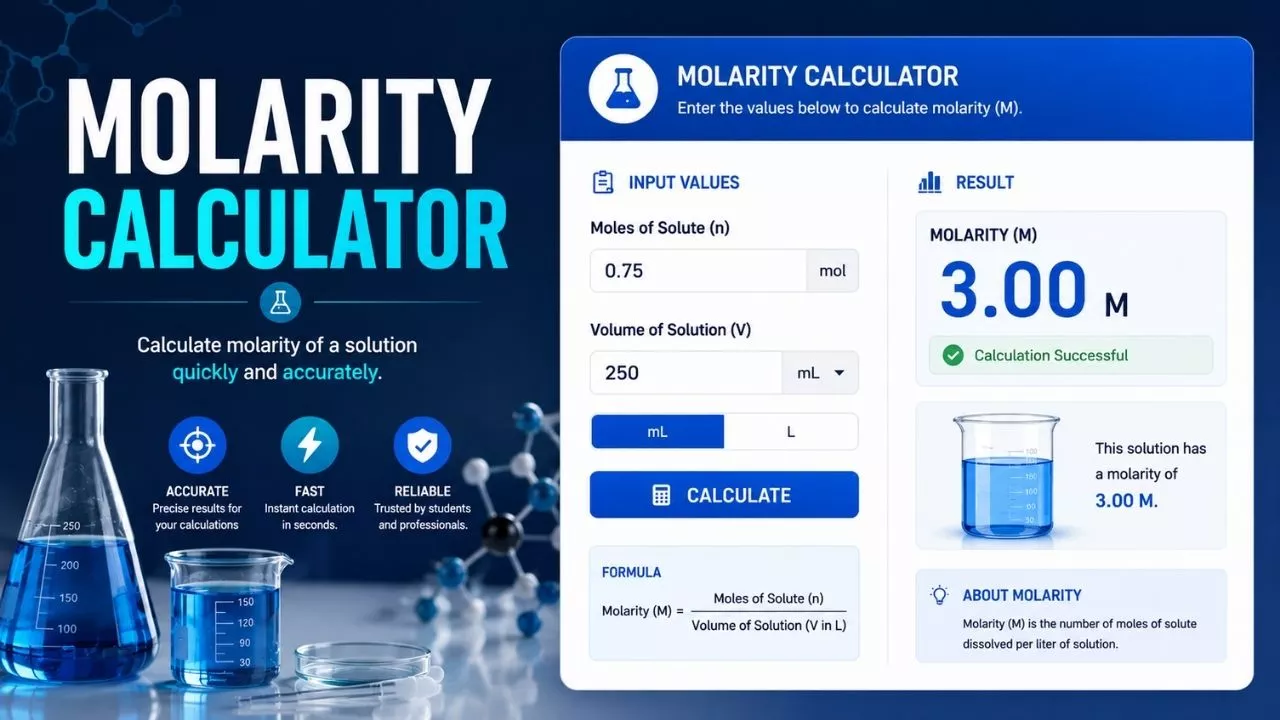
Doing molarity problems by hand can feel tricky at first because you may need to convert grams into moles or milliliters into liters before solving the problem. A molarity calculator saves time by organizing those steps and reducing mistakes.
Many calculators can solve for more than one value. For example, they can find molarity, volume, mass, or even the amount of compound needed when you know the other numbers. That flexibility makes them useful for both simple practice problems and real lab work.
A calculator is especially helpful when the unit changes matter. If a volume is given in milliliters, it must usually be converted to liters before using the molarity formula. A good calculator often handles that part for you, which makes the process easier to follow and less confusing.
How To Use One
Using a molarity calculator usually starts with entering the values you already know. Depending on the version, you may type in the mass of the substance, its molecular weight, and the volume of the solution. After that, the calculator gives the missing value.
Here is a simple example. If you have a substance with a molecular weight of 58.44 g/mol, a mass of 5.844 g, and a final solution volume of 1 liter, the solution is 0.1M because 5.844g is 0.1 mole. The calculator makes that kind of problem fast to solve.
It is important to enter the right units. Molarity uses liters for volume and grams per mole for molecular weight when mass is part of the problem. If the units are wrong, the answer will also be wrong, even if the formula is correct.
Real-Life Use
Molarity is not only for chemistry class. It is used when scientists prepare solutions in labs, when medicines are made in controlled amounts, and when experiments need exact measurements. In these cases, even a small error can change the result of the solution.
For example, if someone is preparing a salt solution, they need to know how much salt to add to a certain volume of water to reach the desired concentration. A molarity calculator helps them figure that out without guessing.
It also helps with dilution problems, where a strong solution is made weaker by adding more liquid. In those cases, formulas like these are often used. That shows how concentration and volume work together when a solution changes.
Common Mistakes
One common mistake is mixing up moles and grams. Grams measure mass, while moles measure the amount of substance, so they are not the same thing. To convert from grams to moles, you need the molecular weight of the substance.
Another mistake is using milliliters instead of liters in the formula. Because molarity is based on liters of solution, a volume like 250 mL should be written as 0.250 L. Skipping that conversion can make the answer 1,000 times too large or too small.
People also sometimes forget that molarity is based on the total solution, not just the solvent. That means the final volume after mixing matters, not only the amount of liquid you started with.
Easy Memory Tip
A simple way to remember molarity is this: amount divided by space. The amount is the number of moles, and the space is the Liters of solution. If the amount goes up, molarity goes up. If the volume goes up, molarity goes down.
You can think of it like lemonade. If you add more powder to the same amount of water, the drink becomes stronger. If you add more water to the same amount of powder, it becomes weaker. That is the same idea behind concentration.
The calculator helps turn that idea into numbers. Instead of guessing whether a solution is strong or weak, you can measure it clearly and exactly. That is why molarity is such a useful chemistry concept.
Final Thought
A molarity calculator is a simple tool, but it solves an important problem. It helps you understand how much solute is in a solution, keeps units organized, and saves time during chemistry work.
Once you understand the formula, the calculator becomes a handy shortcut that makes solving problems much easier to handle.