The following are tools to calculate the ohm value and tolerance based on resistor color codes, the total resistance of a group of resistors in parallel or in series, and the resistance of a conductor based on size and conductivity.
A resistor calculator is one of the easiest tools to use when learning about basic electronics. It helps you find resistor values, understand color codes, and solve simple circuit problems without doing all the math by hand. For anyone working with small projects, school circuits, or hobby electronics, it can save time and reduce confusion.
At first, resistors may seem like tiny parts that do not matter much. But they play a very important role in almost every electronic device. They help control the flow of electric current, protect delicate parts, and keep circuits working the way they should. A resistor calculator makes it easier to understand how these parts behave and how to use them correctly.
If you have ever seen a resistor with colored bands on it and wondered what they mean, this tool can help. It can turn those colors into numbers and show the value in ohms. It can also help when resistors are connected in series or parallel, which are two common ways circuits are built.
What a Resistor Does
A resistor is a small electronic component that limits the flow of current in a circuit. Think of it like a narrow part of a pipe. Water still flows through, but the narrow space slows it down. In the same way, a resistor slows down electricity, so other parts of the circuit do not get too much of it.
This simple job makes resistors very important. Many electronic parts can be damaged if too much current passes through them. Resistors help prevent that. They can also be used to control brightness in lights, adjust sound levels, and manage signals inside devices.
Resistors are found in many common items. They are inside TVs, radios, game controllers, chargers, and toys. Even though they are small and often overlooked, they are working quietly in the background to keep everything safe and stable.
When people are learning electronics, resistors are usually one of the first parts they study. That is because they are easy to understand and useful in many different circuits. Once you understand how a resistor works, it becomes easier to learn about the rest of electronics, too.
Why a Resistor Calculator Helps
A resistor calculator is useful because it takes away guesswork. Instead of trying to remember formulas or decode color bands mentally every time, you can enter the values and get a quick answer. This is especially helpful when you are building a circuit and want to move fast without making mistakes.
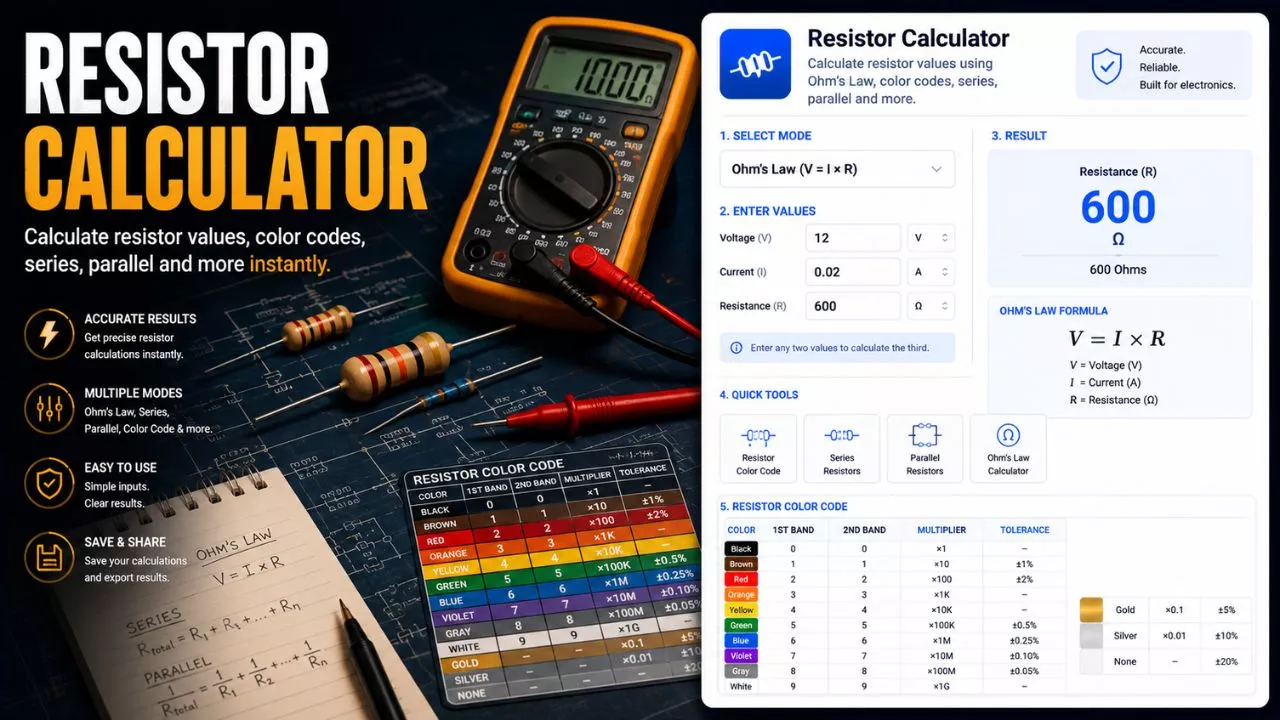
One of the biggest advantages is that it helps with resistor color codes. Many resistors do not show their value in plain numbers. Instead, they use colored stripes. Each color stands for a number or a multiplier. That system works well for manufacturers, but it can be confusing for beginners. A resistor calculator makes the reading process much easier.
It is also helpful when resistors are combined in a circuit. In series, the total resistance is the sum of all resistor values. In parallel, the calculation is more complicated. A calculator can solve both cases quickly. This matters because the total resistance changes how current flows in a circuit.
For students, makers, and DIY electronics fans, this tool is a simple way to avoid errors. It helps confirm whether a circuit idea is practical before anything is connected. That can save time, protect components, and make learning more enjoyable.
Reading Resistor Colors
Resistor color codes may look confusing at first, but they follow a clear pattern. The colored bands on the resistor give information about its value. Usually, the first bands show digits, the next band shows a multiplier, and the last band shows tolerance. Tolerance tells you how much the actual resistor value can vary from the listed value.
This system is useful because resistors are often very small. Printing tiny numbers on them would be difficult, so color bands are a neat solution. Once you learn the code, you can identify resistor values without needing a label or a chart every time.
A resistor calculator makes this easier by translating the colors into a number. You simply choose the colors from a list, and the calculator does the rest. This is helpful when you are holding a resistor in your hand and trying to figure out its exact value.
It also helps you check your own reading. If you think a resistor is 220 ohms, the calculator can confirm whether you are right. That kind of double-check is especially useful when you are just starting out. It builds confidence and helps you learn faster.
Series Circuits
When resistors are connected in series, they are placed one after another in a single path. The electric current has only one route to follow. Because of that, the total resistance is easy to find. You simply add all the resistor values together.
For example, if one resistor is 100 ohms, another is 220 ohms, and another is 330 ohms, the total resistance in series is 650 ohms. This rule is simple, which makes series circuits a good place to start when learning circuit math.
A resistor calculator can do this instantly. Instead of adding the values yourself, you enter them and get the result right away. That is useful when you are testing different combinations and want to see how the circuit changes.
Series circuits are often used when designers want to increase resistance in a controlled way. They are also common in beginner projects because they are easy to build and understand. Even so, you still need to be careful, since the total resistance affects how much current can move through the circuit.
Parallel Circuits
Parallel circuits work differently. In a parallel setup, resistors are connected on separate branches. This means the current has more than one path to follow. Because of that, the total resistance becomes lower than the value of the smallest resistor in the group.
This can be hard to calculate by hand because the formula is not just simple addition. You need to use the reciprocal of each resistor value, combine them, and then take the reciprocal again. That is not difficult once you learn it, but it can take time and lead to mistakes.
A resistor calculator is very useful here. It can quickly find the total resistance for two or more resistors in parallel. This is helpful when you are trying to design a circuit with a specific resistance value but do not have exactly the right resistor in your parts box.
Parallel circuits are common in many real electronics projects. They are also used when multiple parts need to work independently from each other. Understanding how resistance changes in parallel helps you see why circuits behave differently depending on how they are built.
Choosing the Right Resistor
Choosing the right resistor value is an important step in circuit design. A resistor that is too small may allow too much current, while one that is too large may reduce current too much. Either choice can cause problems. The goal is to find a value that matches the needs of the circuit.
A resistor calculator can help you make that choice with more confidence. It lets you test different values and compare the results. This is especially useful if you are following a project guide or adjusting a circuit to work better.
Sometimes you may need to replace a resistor in an old device. If the color bands are hard to read or worn out, a calculator can help you understand what value you need. It can also help when you are experimenting and want to see how a circuit changes with different resistor sizes.
In real life, people use resistors not just to protect parts, but also to control signals and adjust performance. That is why selecting the right value matters so much. A small change in resistance can make a circuit behave differently.
A Simple Example
Imagine a small LED circuit. An LED is a tiny light that needs protection from too much current. If you connect it directly to a power source, it may burn out. That is why a resistor is placed in the circuit with it.
Now, suppose you want the LED to shine at a safe level. You can use a resistor calculator to help find a suitable resistance. If you already know the current and voltage values, the calculator can help you determine the best resistor. If you are working with a series connection, it can also show the total resistance of all parts combined.
This makes the process much easier than guessing. You are not just hoping the circuit will work. You are checking the numbers first. That saves time and makes the project safer.
This same idea applies to many other projects. Whether you are making a blinking light, a small alarm, or a simple classroom experiment, the calculator helps you make better choices. It turns circuit building into a more organized and less stressful process.
Why It Matters for Learning
A resistor calculator is not just a convenience. It is also a learning tool. When you use it, you begin to understand how resistors behave in different situations. Over time, you start to notice patterns, such as how series circuits add resistance and how parallel circuits reduce it.
That kind of learning is useful because electronics becomes much easier when you understand the basics. Instead of memorizing random facts, you start seeing how the parts work together. That gives you a stronger foundation for future projects.
It also helps build problem-solving skills. If a circuit does not work, you can check the resistor values and see whether the issue is in the design. Maybe the resistance is too high. Maybe it is too low. A calculator helps you test those ideas quickly.
For beginners, that is a big advantage. It turns electronics from something confusing into something practical. The more you use the tool, the more comfortable you become with the numbers and ideas behind circuits.
Final Thoughts
A resistor calculator is a simple but powerful tool for anyone learning or working with electronics. It helps read color codes, solve series and parallel circuits, and choose the right resistor for a project. Most importantly, it makes circuit work faster, easier, and more accurate.
Resistors may be small, but they do important work in almost every electronic device. They control current, protect components, and help circuits behave the way they should. A calculator makes it much easier to understand all of that without getting lost in the math.
If you are building your first circuit or just trying to understand how resistor values work, this tool is a smart place to start. It takes a complicated topic and breaks it into something clear and manageable. Once you get used to it, you will likely find that resistor problems are far less intimidating than they first appear.