Please provide any 2 values and click “Calculate” to get the other values in the Ohm’s law equations V = I × R and P = V × I.
Electricity powers almost everything around us, from lights and phones to computers and kitchen appliances. But have you ever wondered how electricity actually works? One of the most important rules that helps us understand electrical circuits is called Ohm’s Law.
To make things even easier, people use something called an Ohm’s Law Calculator. This tool helps you quickly figure out important values like voltage, current, and resistance without doing complex math.
An Ohm’s Law Calculator is especially helpful for students, hobbyists, and anyone working with basic electronics. Instead of memorizing formulas and solving equations step by step, you can simply enter known values and instantly get the answer. This makes learning faster and less confusing.
We will explore what Ohm’s Law is, how the calculator works, why it is useful, and where you might use it in real life. You will also learn how it connects to everyday devices and simple projects. By the end, you will have a strong understanding of how electricity behaves and how to use an Ohm’s Law Calculator confidently.
What Is Ohm’s Law?
Ohm’s Law is a basic rule in electricity that explains the relationship between three important things: voltage, current, and resistance. These three elements work together in any electrical circuit. The law is usually written as:
V = I × R
Here, V stands for voltage, I stands for current, and R stands for resistance. Voltage is the push that moves electricity through a wire. Current is the flow of electric charge. Resistance is what slows down or limits that flow.
To understand this better, imagine water flowing through a pipe. Voltage is like water pressure, current is the amount of water flowing, and resistance is like a narrow pipe that slows the water down. If the pressure increases, more water flows. If the pipe gets tighter, the flow decreases.
Ohm’s Law helps you calculate any one of these values if you know the other two. For example, if you know the voltage and resistance, you can find the current. This is why it is so important in electronics and electrical work.
Understanding this law is the first step in learning how circuits behave. It allows you to predict what will happen when you change parts of a circuit, which is very useful in designing and fixing electronic devices.
What Is an Ohm’s Law Calculator?
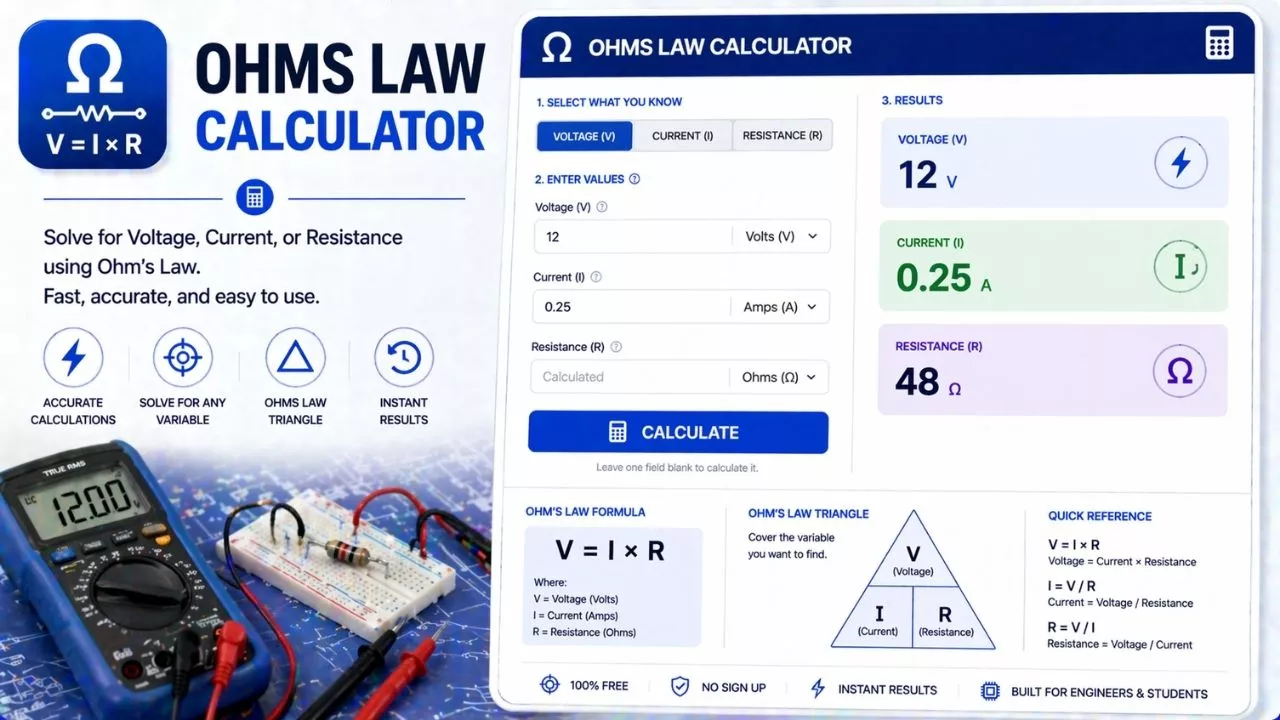
An Ohm’s Law Calculator is a simple digital tool that helps you solve electrical equations quickly. Instead of manually rearranging formulas and calculating values, you can enter known numbers and get instant results.
For example, if you know the voltage and resistance in a circuit, the calculator can tell you the current in seconds. Similarly, if you know current and resistance, it can calculate voltage. This makes it very easy to work with circuits without worrying about mistakes in calculations.
Most Ohm’s Law calculators have three input fields. You fill in any two values, and the calculator finds the third. This is helpful because it removes the need to remember which formula to use. It also saves time, especially when working on multiple problems.
These calculators are available on websites, mobile apps, and even built into some scientific calculators. They are widely used in schools, workshops, and DIY electronics projects.
Another advantage is accuracy. When doing calculations by hand, it is easy to make small errors. A calculator reduces this risk and gives reliable answers every time.
Using an Ohm’s Law Calculator also helps build confidence. As you practice with it, you start to understand how voltage, current, and resistance affect each other in real situations.
How Does an Ohm’s Law Calculator Work?
An Ohm’s Law Calculator works by using the formula V = I × R and its variations. Depending on what values you enter, the calculator rearranges the formula to find the missing value.
If you want to find current, the calculator uses I = V ÷ R. If you want to find resistance, it uses R = V ÷ I. These are all just different forms of the same rule.
Let’s say you enter a voltage of 12 volts and a resistance of 4 ohms. The calculator will divide 12 by 4 and give you a current of 3 amps. This happens instantly, without you needing to solve the equation manually.
The calculator may also check for errors. For example, if you enter zero as resistance, it might show an error because dividing by zero is not possible. This helps prevent incorrect results.
Some advanced calculators also show units and allow you to convert between them. For example, they might let you enter milliamps instead of amps or kilo-ohms instead of ohms.
Many calculators also include visual aids, like diagrams or step-by-step explanations. These features help users understand how the result was calculated, making learning easier.
Overall, the calculator acts like a smart assistant that applies the formula correctly every time and gives fast, accurate answers.
Why Is an Ohm’s Law Calculator Useful?
An Ohm’s Law Calculator is useful because it simplifies electrical calculations and makes learning more accessible. Instead of getting stuck on math, you can focus on understanding how circuits behave.
One major benefit is speed. When working on multiple problems or projects, solving equations by hand can take time. A calculator provides instant answers, allowing you to move forward quickly.
Another benefit is accuracy. Even a small mistake in calculation can lead to incorrect results, especially in real-world applications. A calculator reduces this risk and ensures reliable outcomes.
It is also very helpful for beginners. Learning formulas can sometimes feel overwhelming, but using a calculator allows you to practice without fear. Over time, you naturally become familiar with the relationships between voltage, current, and resistance.
Professionals also use these calculators in their daily work. Electricians, engineers, and technicians rely on them to quickly check values and ensure safety in circuits.
Additionally, it is useful for troubleshooting. If something is not working in a circuit, you can use the calculator to check if the values are correct. This helps identify problems faster.
Overall, an Ohm’s Law Calculator makes working with electricity easier, faster, and more efficient for everyone.
Real-Life Examples of Ohm’s Law
Ohm’s Law is not just a theory. It is used in many everyday situations, often without us realizing it. Understanding these examples can make the concept more relatable.
Consider a simple flashlight. When you insert batteries, they provide voltage. The bulb has resistance, and current flows through it to produce light. If the resistance is too high, the bulb will be dim. If it is too low, the bulb might burn out.
Another example is a phone charger. It controls the amount of current flowing into your device. If too much current flows, it can damage the battery. This is why chargers are carefully designed using principles like Ohm’s Law.
In household wiring, resistance plays a key role in safety. Wires are chosen with specific resistance levels to handle the required current without overheating.
Electric heaters also rely on resistance. They use materials that resist the flow of electricity, which generates heat. This is how they warm up a room.
Even in cars, Ohm’s Law is used to design electrical systems like headlights and dashboards. Engineers calculate the right values to ensure everything works safely and efficiently.
These examples show how important this law is in daily life. It helps ensure that devices work properly and safely.
Tips for Using an Ohm’s Law Calculator Effectively
Using an Ohm’s Law Calculator is simple, but a few tips can make it even more effective. These tips help you get accurate results and better understand your calculations.
First, always check your units. Make sure voltage is in volts, current is in amps, and resistance is in ohms. If the units are different, convert them before entering values.
Second, enter only two values. The calculator needs exactly two inputs to find the third. Entering too many values can cause confusion or errors.
Third, double-check your inputs. A small typing mistake can lead to a completely different result. Take a moment to review your numbers before calculating.
Fourth, understand the result. Do not just rely on the answer. Try to think about whether the result makes sense. For example, if resistance is high, the current should be lower.
Fifth, use it as a learning tool. Instead of just getting answers, try to predict the result before using the calculator. This helps build your understanding over time.
Finally, explore advanced features. Some calculators offer graphs, unit conversions, or explanations. These can make learning more interactive and interesting.
By following these tips, you can use the calculator more effectively and gain a deeper understanding of electrical concepts.
Conclusion
An Ohm’s Law Calculator is a powerful and easy-to-use tool that helps you understand and work with electricity. It takes a complex concept and makes it simple by providing quick and accurate calculations.
By learning how voltage, current, and resistance are connected, you can better understand how electrical devices work. The calculator supports this learning by removing the difficulty of manual calculations.
Whether you are studying, working on a project, or simply curious about how things work, this tool can be very helpful. It allows you to explore electrical concepts with confidence and clarity.
As you continue learning, you will find that Ohm’s Law is one of the most important building blocks in electronics. Using a calculator alongside this knowledge makes the process even smoother.
With practice, you will not only rely on the calculator but also develop a strong understanding of the concepts behind it. This combination of knowledge and tools can help you solve problems, build projects, and better understand the technology around you.