Use the following mileage calculator to determine the travel distance, in terms of miles, and time taken by car to travel between two locations in the United States, disregarding traffic conditions.
What Is a Mileage Calculator?
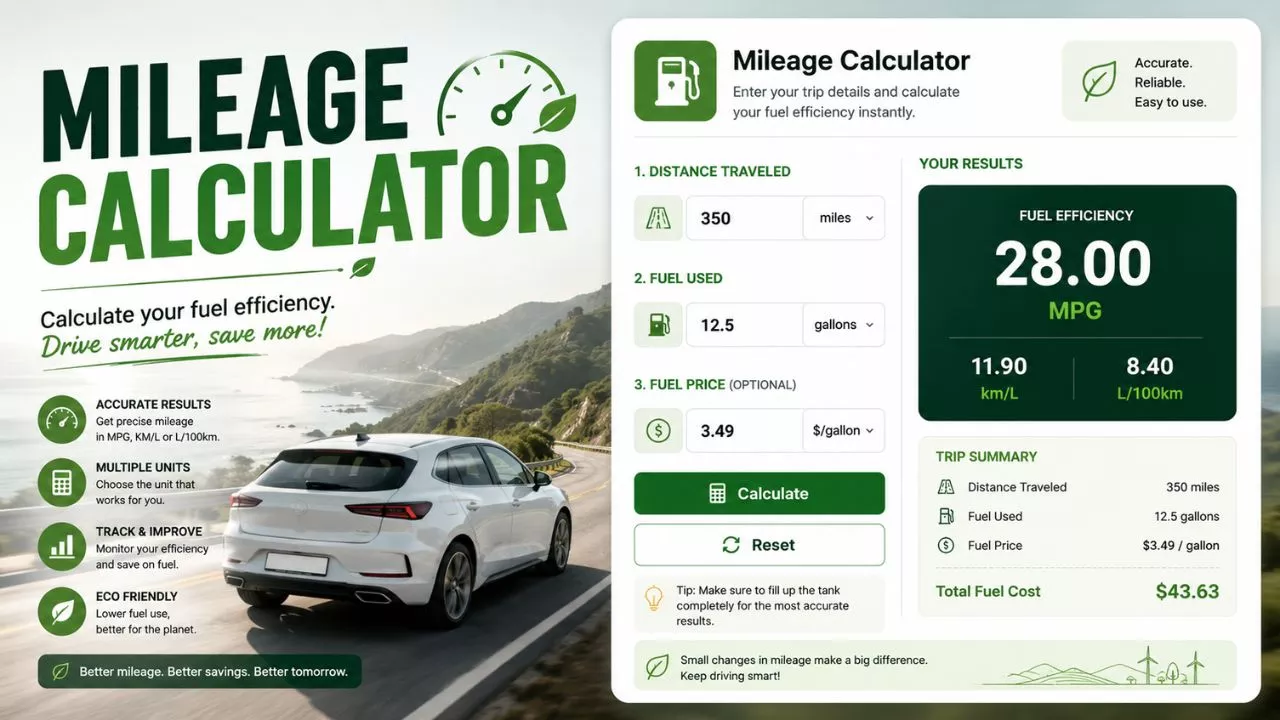
A mileage calculator is a tool that helps you find out how far a vehicle can travel using a certain amount of fuel. It can also tell you how much fuel your vehicle uses for a certain distance. In simple words, it helps you understand how efficient your vehicle is.
For example, if your scooter travels 40 kilometers using 1 liter of petrol, its mileage is 40 kilometers per liter. A mileage calculator helps you find this value quickly without doing complicated math.
This tool is very useful for people who travel daily, such as going to school, work, or the market. It helps you save money by understanding how much fuel you use. It also helps you compare different vehicles before buying one.
You can use a mileage calculator in many ways. Some people use mobile apps, while others use online websites. You can also calculate mileage manually using a simple formula.
Understanding mileage is important because fuel prices are increasing. If you know your vehicle’s mileage, you can plan your trips better and avoid wasting fuel. It also helps you take better care of your vehicle.
In short, a mileage calculator is a smart and easy way to keep track of fuel usage and make better decisions while traveling.
Why Is Mileage Important?
Mileage is important because it tells you how efficiently your vehicle uses fuel. When your vehicle gives good mileage, it means it can travel more distance with less fuel. This helps you save money and reduce fuel usage.
For students and families, saving money on fuel is very helpful. If your bike or car uses less petrol or diesel, you do not need to refill it often. This means fewer visits to the petrol pump and more savings in your pocket.
Mileage is also important for the environment. When vehicles use less fuel, they produce fewer harmful gases. These gases can cause air pollution and harm our health. So, better mileage means cleaner air and a healthier planet.
Another reason why mileage matters is that it helps you choose the right vehicle. When buying a bike or car, people often check its mileage first. A vehicle with higher mileage is usually preferred because it is more economical.
Mileage also shows how well your vehicle is maintained. If your vehicle suddenly starts giving low mileage, it may need servicing. Checking mileage regularly can help you detect problems early.
In simple terms, mileage is not just about saving fuel. It is about saving money, protecting the environment, and keeping your vehicle in good condition.
How Does a Mileage Calculator Work?
A mileage calculator works using a very simple formula. It calculates mileage by dividing the total distance traveled by the amount of fuel used.
The basic formula is:
Mileage = Distance traveled ÷ Fuel used
For example, if your bike travels 100 kilometers using 2 liters of petrol, the mileage is:
100 ÷ 2 = 50 kilometers per liter
This means your bike gives 50 km per liter.
To use a mileage calculator, you need two pieces of information. First, you need to know the distance traveled. Second, you need to know how much fuel was used. Once you enter these values into the calculator, it gives you the mileage instantly.
Some online calculators also allow you to calculate fuel cost. You can enter the fuel price and distance to find out how much money you will spend on fuel.
Mileage calculators are designed to be easy to use. Even a 7th-grade student can use them without any difficulty. They save time and reduce the chances of making mistakes in calculations.
In today’s digital world, many apps and websites offer mileage calculators. These tools make it even easier to track your vehicle’s performance and fuel usage.
Types of Mileage Calculators
There are different types of mileage calculators available, and each one serves a specific purpose. Understanding these types can help you choose the right one for your needs.
The most common type is the basic mileage calculator. This calculator only requires distance and fuel used to calculate mileage. It is simple and easy to use.
Another type is the fuel cost calculator. This calculator helps you find out how much money you will spend on fuel for a trip. You need to enter the distance, mileage, and fuel price. It then gives you the total cost.
There are also trip calculators. These calculators help you plan long journeys. They can estimate fuel usage, travel time, and total cost. This is very useful for family trips or vacations.
Some advanced calculators are available in mobile apps. These apps can track your daily travel and calculate mileage automatically. They also store your data so you can check your vehicle’s performance over time.
Modern vehicles sometimes have built-in mileage calculators. These systems show real-time mileage on the dashboard. This helps drivers understand fuel usage while driving.
Each type of mileage calculator has its own benefits. Choosing the right one depends on what you want to calculate and how detailed you want the information to be.
How to Calculate Mileage Manually
Even though digital tools are available, it is useful to know how to calculate mileage manually. This helps you understand the concept better and makes you more confident in using calculators.
To calculate mileage manually, follow these steps:
First, fill your vehicle’s fuel tank completely. Note down the reading of the odometer, which shows the total distance traveled by the vehicle.
Next, use your vehicle normally for a few days. After that, refill the tank again and note how many liters of fuel were added.
Then, check the new odometer reading. Subtract the old reading from the new reading to find the distance traveled.
Now use the formula:
Mileage = Distance traveled ÷ Fuel used
For example, if your vehicle traveled 150 kilometers and used 3 liters of fuel, the mileage is:
150 ÷ 3 = 50 kilometers per liter
This method is simple and accurate if done carefully. It also helps you track changes in your vehicle’s performance.
Manual calculation is especially helpful when you do not have access to online tools. It is a great way to learn basic math and understand real-life applications.
Tips to Improve Your Vehicle’s Mileage
Improving mileage is important for saving fuel and money. There are several simple tips that can help you get better mileage from your vehicle.
- Drive at a steady speed. Sudden acceleration and braking use more fuel. Smooth driving helps improve mileage.
- Keep your tires properly inflated. Low tire pressure increases friction and reduces mileage. Check tire pressure regularly.
- Service your vehicle on time. Clean engines and properly maintained parts work more efficiently and use less fuel.
- Avoid carrying extra weight. Heavy loads make the engine work harder, which increases fuel consumption.
- Switch off the engine when not in use. Keeping the engine running while waiting wastes fuel.
- Use good-quality fuel. Poor-quality fuel can reduce engine performance and mileage.
- Plan your trips wisely. Avoid traffic and choose shorter routes when possible.
By following these tips, you can improve your vehicle’s mileage and reduce fuel costs. These small changes can make a big difference over time.
Common Mistakes While Calculating Mileage
Many people make mistakes while calculating mileage, which can lead to incorrect results. Understanding these mistakes can help you avoid them.
One common mistake is not filling the tank completely. If the tank is not full, the calculation will not be accurate.
Another mistake is forgetting to note the odometer reading. Without this, you cannot calculate the distance traveled correctly.
Some people also enter incorrect values in the calculator. Even a small error in numbers can give wrong results.
Using different units can also cause confusion. For example, mixing kilometers and miles can lead to incorrect calculations. Always use the same unit.
Another mistake is calculating mileage over a very short distance. This can give inaccurate results because small variations can affect the calculation.
Ignoring vehicle maintenance is also a problem. Poorly maintained vehicles give inconsistent mileage, making calculations less reliable.
By avoiding these mistakes, you can calculate mileage more accurately and understand your vehicle’s performance better.
Conclusion: Why You Should Use a Mileage Calculator
A mileage calculator is a simple yet powerful tool that helps you understand how your vehicle uses fuel. It is easy to use and provides valuable information that can save money and improve efficiency.
By using a mileage calculator, you can track your vehicle’s performance, plan trips better, and reduce fuel expenses. It also helps you make smarter decisions when buying a new vehicle.
For students, learning about mileage calculators is a great way to connect math with real-life situations. It shows how basic calculations can be useful in everyday life.
Whether you use an app, a website, or manual calculation, the important thing is to keep track of your mileage regularly. This helps you stay aware of your fuel usage and maintain your vehicle properly.
In today’s world, where fuel prices are rising and pollution is a concern, understanding mileage is more important than ever. A mileage calculator makes this task simple and accessible for everyone.
Start using a mileage calculator today and take a smart step towards saving money and protecting the environment.