An easy way to calculate gas mileage is to remember the odometer reading or to reset the mileage counter when filling up a gas tank. When doing so next time, obtain the mileage accrued between the two gas fill-ups. Then divide the mileage figure by the amount of gas filled the second time to obtain the gas mileage.
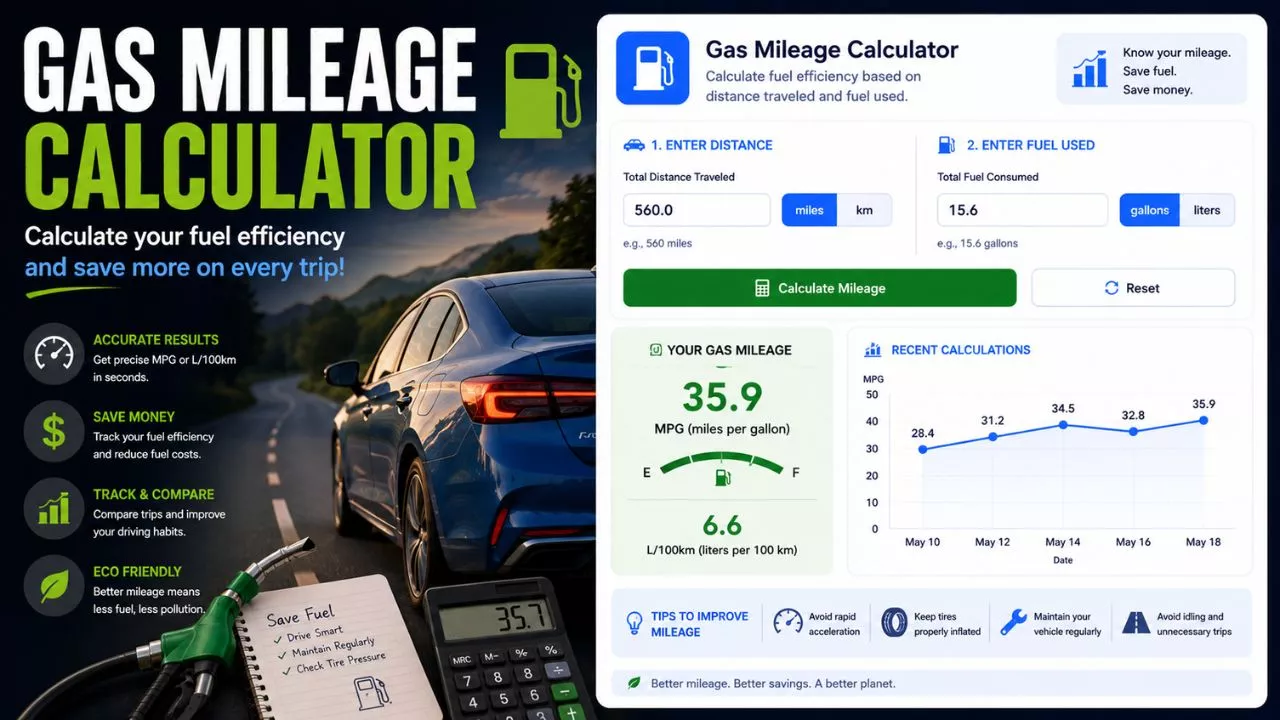
Have you ever wondered exactly how much it costs you to drive to work every day? Or whether your car is actually getting the fuel economy the dealership promised?
With gas prices constantly fluctuating, knowing your vehicle’s exact fuel efficiency is one of the smartest things you can do for your wallet. Whether you track it in Miles Per Gallon (MPG) or Kilometers Per Liter (Km/L), keeping an eye on your gas mileage helps you budget accurately, spot vehicle maintenance issues early, and reduce your carbon footprint.
That’s exactly why we built our Gas Mileage Calculator, a fast, simple way to figure out exactly what your car is burning.
How to Use the Gas Mileage Calculator
Calculating your gas mileage is a breeze. You don’t need complicated math; you just need to keep track of a few numbers the next time you visit the gas station. Here is the step-by-step method:
- Fill up your tank: The next time you get gas, fill the tank full.
- Record your odometer: Write down your car’s exact mileage (your Previous Odometer Reading). Alternatively, reset your trip counter to zero.
- Drive normally: Go about your regular driving routine until it’s time to get gas again.
- Fill up and record again: At the gas station, fill the tank full once more. Note exactly how many gallons (or liters) it took to fill it up. Write down your new odometer reading (your Current Odometer Reading).
Simply plug those three numbers, Current Odometer, Previous Odometer, and Gas Added, into our calculator above.
Pro-tip: Enter the price you paid per gallon/liter to see exactly how much every mile is costing you!
10 ways to Improve Your Gas Mileage
Even though we are aware that engines need fuel to run, that does not mean you can’t make some small changes to help you gain some fuel savings.
- Keep tires pumped up. Tires that are underinflated have a higher rolling resistance on the road. This means that with every kilometer traveled, your tires generate more friction and rolling resistance, and hence, will increase fuel consumption. If all your tires are underinflated by 10 psi, this could reduce fuel efficiency by up to 10%.
- Lose the weight in your boot. For those with a habit of keeping everything and anything in the boot, in addition to emergency spares, think twice when loading up next time. Every extra 50kg your car puts on increases fuel consumption by 2%.
- Drive with AC. Driving with the windows down at speeds faster than 80km/h causes a lot of wind resistance and costs you a lot more fuel. Contrary to what you may think, in this situation, it’s simply more fuel-efficient to drive with the aircon on.
- Don’t go too fast or too slow. When cruising down a highway, your engine works hard to overcome wind resistance. You’ll burn up to 15% more fuel at 100 km/h and 25% more at 110 km/h. That might tempt you to drive slowly, but if you drive slower than 50 km/h, your engine would drop to a lower gear, thus using up more fuel. In conclusion, a steady 50 – 90 km/h on the highway is best to achieve optimal fuel economy.
- Remain steady when accelerating. Avoid revving your accelerator to high revolutions per minute (RPM). It’s better for fuel economy, as your engine uses less fuel when it is revolving more slowly, at a lower RPM.
- Avoid braking aggressively. Slamming on the brakes increases fuel consumption as you need to accelerate again later. This is especially true if you follow too closely behind the vehicle in front of you. Not to mention, tailgating is dangerous and something to avoid.
- Cruise in top gear. If you’re driving an automatic car, make use of cruise control to keep your speed constant. And if you’re driving a manual car, maintain a higher gear when appropriate. In each of these instances, your engines go through fewer revolutions per minute (RPM) and will reduce your fuel consumption.
- Practice predictive driving. Look to the road ahead and plan your next move. Instead of slamming on the brakes to a complete stop, try slowing down as you approach the red light. Or when reaching the foot of a hill, start accelerating as you edge closer to it rather than when you approach it. Avoid hard accelerations when moving your car from a complete stop, or climbing a hill as it will increase fuel consumption.
- Plan your rush hour route. Stop-start traffic puts a lot of pressure on your engine, thus burning more fuel. When possible, plan your commute to and from work carefully to help you avoid the worst of peak traffic.
- Don’t stay idle for long. If you are waiting for something or someone for more than three minutes, turn off your engine. You may not be moving, but as long as your engine is on, it’s burning precious fuel.
And a final word. Regular car servicing helps maintain your engine’s fuel efficiency. Engine parts work closely in tandem. If poorly maintained, sludge and corrosion will build up between the parts, making it difficult for the engine to work smoothly.
This is also why engine oils are important. A good high-performance engine oil can help to reduce friction in the engine, combat sludge, and improve fuel economy.