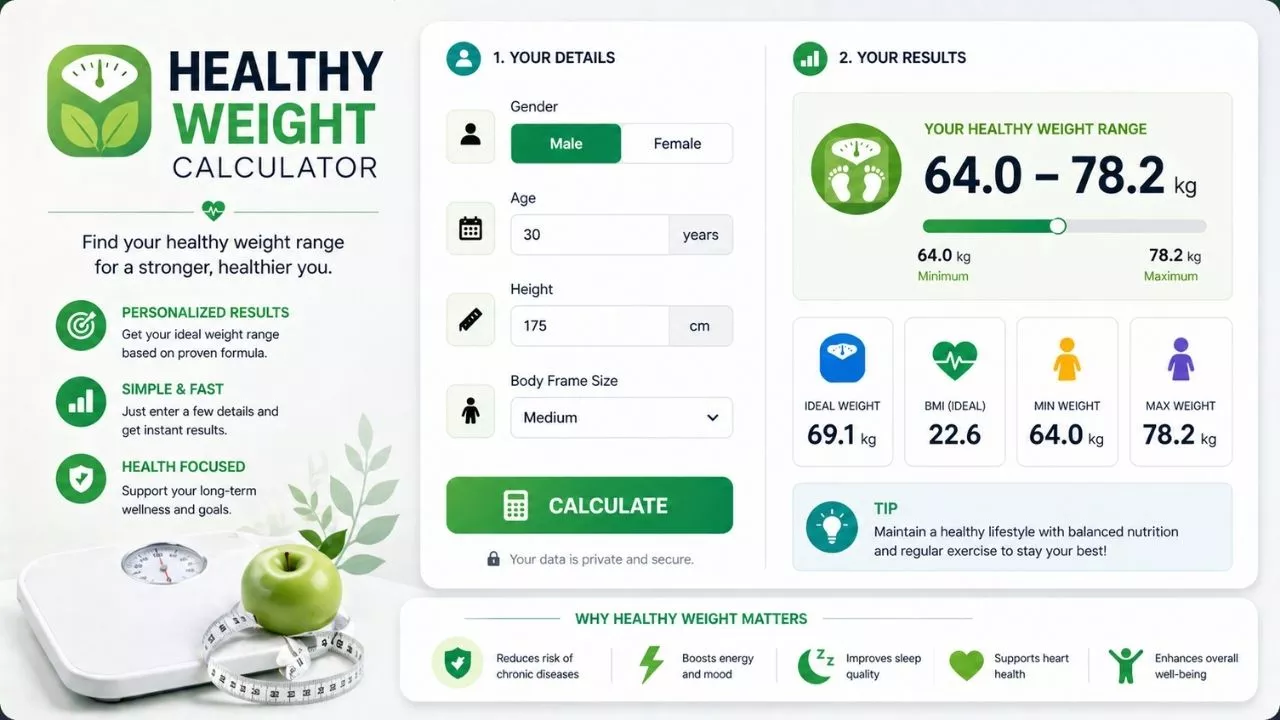
What Is a Healthy Weight Calculator?
A healthy weight calculator is a tool that helps you understand whether your weight is within a range that is considered healthy for your height, age, and sometimes gender. It does not judge how you look. Instead, it gives you a general idea of how your body compares to standard health guidelines.
Most calculators use a formula called Body Mass Index, or BMI. BMI takes your weight and height and turns them into a number. This number falls into categories such as underweight, normal weight, overweight, or obese. While it sounds complicated, the calculator does all the work for you.
In the United States, healthy weight calculators are commonly used by doctors, fitness trainers, and even schools. They are often the first step in understanding overall health. However, it is important to remember that these tools are not perfect. They give a general idea, not a final answer.
For example, someone who exercises a lot and has strong muscles may have a higher weight but still be very healthy. The calculator might not fully reflect that. This is why it is best to use it as a guide rather than a strict rule.
Using a healthy weight calculator can help you start thinking about your health in a positive way. It can also motivate you to make small changes that improve your daily life, like eating better or being more active.
How Does a Healthy Weight Calculator Work?
A healthy weight calculator usually works by asking for a few basic details such as your height and weight. Some advanced versions may also ask for age, gender, and activity level. Once you enter this information, the calculator uses a formula to estimate your healthy weight range.
The most common formula used is BMI. The formula compares your weight to your height. The result is a number that places you into a category. For adults in the United States, the categories are generally:
- Underweight: BMI below 18.5
- Normal weight: BMI between 18.5 and 24.9
- Overweight: BMI between 25 and 29.9
- Obese: BMI 30 or higher
Some calculators go beyond BMI and give a healthy weight range instead of just a category. This range shows the minimum and maximum weight that is considered healthy for your height.
For example, if someone is 5 feet 6 inches tall, the calculator might suggest a healthy weight range between 118 and 154 pounds. This gives a clearer idea of what is considered healthy rather than focusing on a single number.
These calculators are easy to find online and take only a few seconds to use. Many are free and available on health websites. They are designed to be simple so that anyone can understand and use them without confusion.
Why Knowing Your Healthy Weight Matters
Knowing your healthy weight is important because it helps you understand how your body is doing. It is not about looking a certain way. It is about staying healthy and feeling good every day.
When your weight is in a healthy range, your body can work more efficiently. Your heart does not have to work as hard, your joints feel less stress, and your energy levels are often higher. This can make everyday activities like walking, playing sports, or even climbing stairs easier.
Being outside the healthy weight range can increase the risk of certain health problems. For example, carrying too much weight can raise the chances of conditions like high blood pressure, type 2 diabetes, and heart disease. On the other hand, being underweight can mean your body is not getting enough nutrients, which can lead to weakness or a weaker immune system.
In the United States, many health programs encourage people to check their weight regularly as part of overall wellness. This does not mean you need to worry about your weight every day. Instead, it is about staying aware and making balanced choices.
Understanding your healthy weight can also help you set realistic goals. Instead of aiming for a number you see in media, you can focus on what is actually right for your body. This makes it easier to stay motivated and build long-term healthy habits.
Different Types of Healthy Weight Calculators
There is more than one type of healthy weight calculator, and each one looks at your body in a slightly different way. While BMI is the most common, other tools can give a more detailed picture.
One popular option is the waist-to-height ratio calculator. This tool compares your waist size to your height. It helps show how fat is distributed around your body, which is important because fat around the waist can affect health more than fat in other areas.
Another type is the body fat percentage calculator. This estimates how much of your body is made up of fat compared to muscles, bones, and water. This can be useful because two people with the same weight can have very different body compositions.
There are also calculators that consider age and gender. These are often used for children and teens because their bodies are still growing. For adults, these factors can still matter, especially when it comes to metabolism and muscle mass.
Some advanced tools even include activity level. For example, someone who exercises daily may have a different healthy weight range than someone who is less active.
Each calculator has its own strengths and limits. Using more than one can give you a better understanding of your overall health. Instead of relying on a single number, you get a fuller picture of how your body is doing.
Limitations of Healthy Weight Calculators
While healthy weight calculators are useful, they are not perfect. They provide estimates, not exact answers. Understanding their limits can help you use them more wisely.
One of the biggest limitations is that many calculators do not consider muscle mass. Muscle weighs more than fat, so someone who is strong and fit might appear overweight according to BMI, even if they are very healthy.
Another limitation is body shape. People store fat differently. Some may carry more weight around their hips, while others carry it around their stomach. A simple calculator may not capture these differences.
Age is another factor. As people get older, their bodies change. Muscle mass may decrease, and fat distribution can shift. Basic calculators may not fully adjust for these changes.
Health is also influenced by more than just weight. Factors like diet, sleep, stress, and physical activity all play important roles. A person can be within a healthy weight range but still have unhealthy habits.
For example, someone might have a normal BMI but eat mostly processed foods and rarely exercise. In this case, the calculator would not show the full picture of their health.
Because of these limitations, it is best to use healthy weight calculators as a starting point. For a deeper understanding, it is helpful to talk to a healthcare provider who can consider your full health profile.
How to Use a Healthy Weight Calculator the Right Way
Using a healthy weight calculator correctly can make a big difference in how helpful it is. The first step is to enter accurate information. Measure your height and weight carefully rather than guessing. Even small errors can change the result.
Once you get your result, focus on understanding the range instead of worrying about a single number. A healthy weight is not one exact point. It is a range where your body functions well.
It is also important to avoid comparing your results with others. Every person is different. What is healthy for one person may not be the same for another. Your goal should be to improve your own health, not match someone else.
Use the results as a guide for making small, realistic changes. For example, if your weight is slightly above the healthy range, you might start by adding a daily walk or choosing healthier snacks. Small steps are easier to maintain over time.
Do not rely on the calculator alone. Pay attention to how you feel. Energy levels, sleep quality, and overall mood are also important signs of health.
If you are unsure about your results, consider speaking with a doctor or nutrition expert. They can provide advice that is tailored to your specific needs.
Tips for Reaching and Maintaining a Healthy Weight
Reaching a healthy weight does not require extreme diets or intense workouts. Simple, consistent habits can make a big difference over time.
Start with balanced eating. Include a mix of fruits, vegetables, whole grains, proteins, and healthy fats. Try to limit sugary drinks and highly processed foods. Drinking enough water is also important for overall health.
Regular physical activity is another key factor. This does not mean you need to spend hours at the gym. Activities like walking, biking, dancing, or playing sports can all help. Aim for movement that you enjoy so it becomes part of your routine.
Sleep is often overlooked but plays a major role in weight and health. Getting enough rest helps your body recover and maintain balance. Most people need around 7 to 9 hours of sleep each night.
Managing stress is also important. High stress levels can affect eating habits and energy levels. Simple activities like deep breathing, spending time outdoors, or talking to friends can help reduce stress.
Consistency matters more than perfection. You do not need to follow a strict plan every day. What matters is building habits that you can stick with over time.
By combining these habits with the guidance of a healthy weight calculator, you can create a balanced approach to staying healthy and feeling your best.