Use the calculator below to estimate electricity usage and cost based on the power requirements and usage of appliances. The amount of time and power that each appliance is used varies significantly between households, so for the best results, adjust the usage for each appliance to most accurately reflect your personal usage.
Electricity is something we use every single day, but many people do not really think about how much it costs until the bill arrives. An electricity calculator is a simple tool that helps you understand how much energy your appliances use and how much money you are spending.
It can turn confusing numbers into something clear and useful. Instead of guessing, you can see real estimates and make better decisions for your home.
What Is an Electricity Calculator?
An electricity calculator is a tool that helps you figure out how much electricity your devices use and how much that usage costs. Every appliance in your home, like a refrigerator, air conditioner, or TV, uses a certain amount of power measured in watts. The calculator takes this power usage, along with how long you use the device, and converts it into energy usage, usually measured in kilowatt-hours.
For example, if a device uses 1000 watts and runs for one hour, it uses 1 kilowatt-hour of electricity. If your electricity rate is $0.15 per kilowatt-hour, that one hour costs you $0.15. The calculator does all this math for you quickly and clearly.
Most electricity calculators allow you to enter details like appliance wattage, hours of use per day, and your local electricity rate. Some even include built-in lists of common appliances, so you do not need to guess the numbers. This makes it easy for anyone to use, even without technical knowledge.
By using this tool, you can understand where your electricity is going. Instead of just seeing a total bill, you can break it down by device and usage. This helps you take control of your energy habits and make smarter choices that can lower your monthly costs.
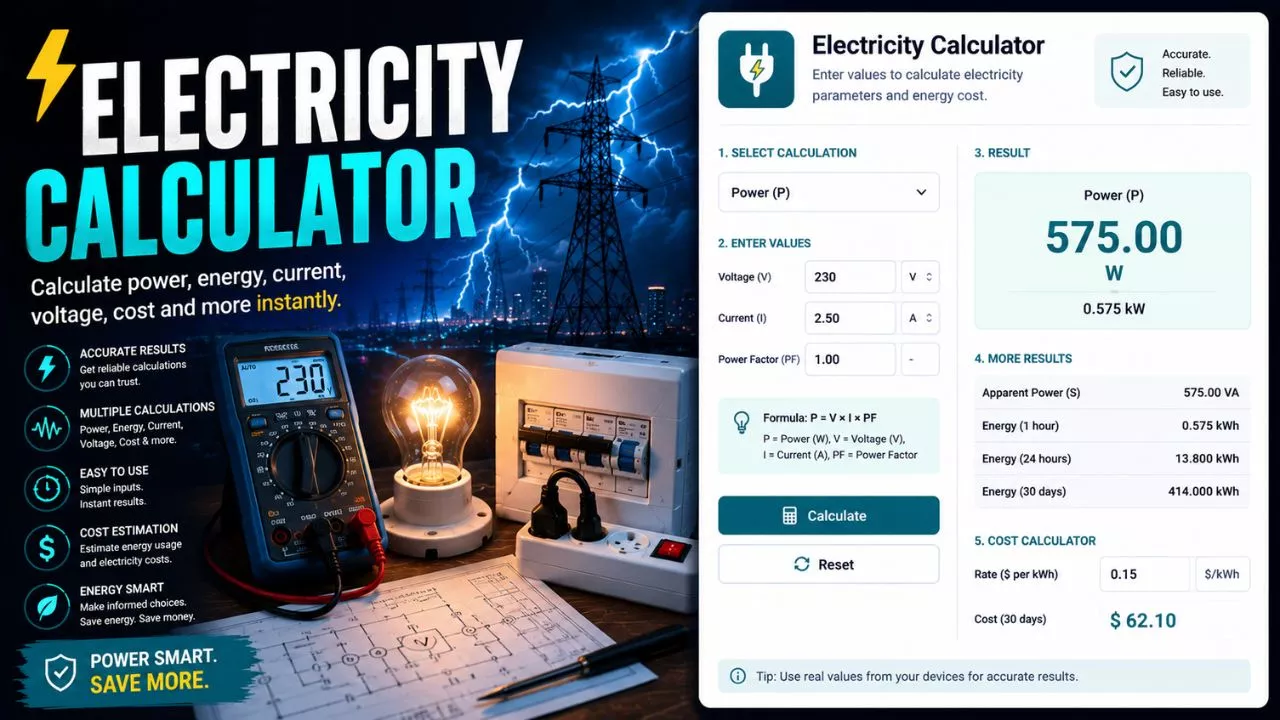
How to Calculate Electricity Cost
Calculating electricity cost might sound complicated at first, but it is actually quite simple once you understand the steps. The main idea is to figure out how much energy an appliance uses and then multiply that by your electricity rate.
The basic formula is:
Energy used in kilowatt-hours equals wattage multiplied by hours of use, divided by 1000.
After that, you multiply the energy used by your electricity rate to get the cost.
For example, imagine you have a 1500-watt heater that you use for 2 hours a day. First, you calculate energy usage:
1500 multiplied by 2 equals 3000 watts per day. Divide that by 1000, and you get 3 kilowatt-hours per day.
If your electricity rate is $0.20 per kilowatt-hour, then:
3 multiplied by 0.20 equals $0.60 per day.
Over a month, that becomes about $18. This shows how quickly costs can add up when using high-power appliances regularly.
An electricity calculator simplifies this process. You just enter the numbers, and it gives you the result instantly. It also helps reduce errors and saves time. This is especially helpful if you want to calculate costs for multiple devices or compare different usage habits.
Understanding this process gives you the power to control your spending and avoid surprises on your electricity bill.
Estimating Your Monthly Electricity Bill
Estimating your monthly electricity bill helps you plan your budget and avoid unexpected costs. Instead of waiting for your bill to arrive, you can predict it based on your daily usage.
To estimate your bill, you need to know how many kilowatt-hours your household uses in a day or a week. You can calculate this by adding up the usage of all your appliances. For example, your refrigerator might run all day, while your washing machine runs only a few times a week.
Once you know your total daily usage, multiply it by the number of days in a month. Then multiply that number by your electricity rate. This gives you a rough estimate of your monthly bill.
For instance, if your total daily usage is 20 kilowatt-hours and your rate is $0.15, your daily cost is $3. Over 30 days, your bill would be about $90.
Electricity calculators make this process easier by allowing you to input multiple devices and automatically adding up the total usage. Some tools also let you adjust usage patterns, such as increasing air conditioner use during summer months.
Keep in mind that actual bills may include additional charges like taxes or service fees. However, an estimate is still very useful for planning and tracking your energy habits. It helps you stay aware of your consumption and make changes before your bill gets too high.
Tracking Multiple Devices at Home
Most homes have many devices running at the same time, and each one adds to the total electricity usage. Tracking multiple devices can help you understand which ones use the most energy and where you can make changes.
An electricity calculator allows you to enter several appliances at once. You can list items like lights, fans, computers, kitchen appliances, and heating or cooling systems. Each device has its own wattage and usage time, which the calculator uses to estimate total energy consumption.
For example, a laptop might use only 50 watts, while an air conditioner can use over 2000 watts. Even if you use the laptop for many hours, the air conditioner may still cost more because of its high power usage.
Tracking devices also helps you notice patterns. You might find that certain appliances are used more often than you thought. For instance, leaving lights on in multiple rooms or keeping devices plugged in even when not in use can increase your bill.
Some advanced calculators or apps allow you to save your device list and update it over time. This helps you keep track of changes, such as adding new appliances or reducing usage.
By understanding how each device contributes to your total energy use, you can make smarter choices. This could include using certain appliances less often, replacing old devices, or changing your daily habits to reduce energy consumption.
Ways to Save Energy and Reduce Costs
Saving electricity does not always require big changes. Small actions can make a big difference over time. Once you understand your energy usage through an electricity calculator, you can start making simple adjustments to reduce your costs.
One effective way to save energy is by turning off devices when they are not in use. Many appliances continue to draw power even when they are turned off but still plugged in. Unplugging them or using power strips can help reduce this hidden usage.
Another useful step is switching to energy-efficient appliances. Modern devices often use less power while providing the same performance. For example, LED bulbs use much less electricity than traditional incandescent bulbs and last longer as well.
You can also adjust how and when you use certain appliances. Running washing machines or dishwashers with full loads instead of partial loads can reduce the number of cycles. Setting your thermostat a few degrees higher in summer or lower in winter can also lower energy use without affecting comfort too much.
Using natural light during the day and improving insulation in your home can further reduce the need for electricity. Even small habits, like closing doors to keep cool or warm air inside, can make a noticeable difference.
By combining these strategies with regular tracking using an electricity calculator, you can take control of your energy usage. Over time, these changes can lead to lower bills and a more efficient home.
Why Using an Electricity Calculator Matters
An electricity calculator is more than just a tool for numbers. It helps you become aware of how your daily actions affect your energy usage and your wallet. Without this understanding, it is easy to waste electricity without realizing it.
When you use a calculator regularly, you start to see the impact of different appliances and habits. For example, you may discover that reducing air conditioner usage by just one hour a day can save a noticeable amount each month. This kind of insight makes it easier to make better choices.
It also helps you set goals. You might aim to reduce your monthly usage by a certain percentage or stay within a budget. By tracking your progress, you can see what works and what needs to change.
For families, it can also be a great way to involve everyone in saving energy. When everyone understands how electricity is used, they are more likely to take part in reducing waste.
In the long run, using an electricity calculator can lead to better habits, lower costs, and a more energy-efficient lifestyle. It gives you control, clarity, and confidence when managing your home’s electricity use.
Amount of energy used by common appliances
Below is a table that shows the estimated energy requirements of various appliances (these values can vary significantly depending on the appliance). It is important to note that the requirements listed on the packaging of an appliance generally reflect the maximum energy requirements of an appliance.
Typical usage of the appliance likely results in far lower energy use than stated, so it cannot be calculated directly as power requirement × time.
| Common appliance | Estimated energy use |
|---|---|
| Air conditioner (central) | 3500–5000 W |
| Air conditioner (window) | 500–1440 W |
| Blender | 300–1000 W |
| Clothes dryer (electric) | 3000–6000 W |
| Coffee maker | 800–1400 W |
| Computer (desktop) | 60–300 W |
| Dishwasher | 1200–2400 W |
| Electric kettle | 1500–1800 W |
| Electric oven (single) | 2000–5000 W |
| Electric range | 2000–5000 W |
| Electric water heater | 3000–4500 W |
| Fan (ceiling) | 50–75 W |
| Fan (portable) | 50–100 W |
| Freezer (chest) | 100–200 W |
| Freezer (upright) | 150–250 W |
| Hair dryer | 1200–1875 W |
| Iron | 1000–1800 W |
| Laptop | 50–100 W |
| Microwave oven | 600–1500 W |
| Refrigerator (frost-free) | 725–1100 W |
| Refrigerator (top-freezer) | 350–600 W |
| Refrigerator (bottom-freezer) | 450–800 W |
| Space heater (electric) | 750–1500 W |
| Television (CRT) | 120–180 W |
| Television (LCD) | 150–400 W |
| Television (LED) | 50–150 W |
| Toaster | 800–1500 W |
| Toaster oven | 1200–1800 W |
| Vacuum cleaner (upright) | 600–1200 W |
| Washing machine (top-load) | 350–500 W |
| Washing machine (front-load) | 200–500 W |
| Water pump | 250–1000 W |
| Wi-Fi router | 2.5–12 W |
| Window fan | 40–100 W |