Please provide a shoe or foot size below to convert to the shoe sizes of other countries.
Shoe size is a complicated topic due to the lack of a global standard. Differences in the way shoe size is measured and determined in various countries, in the feet of men vs. women, in the way that different brands label and manufacture their shoes, and even the fact that individuals often have different-sized feet, all contribute to the complication in finding a proper shoe size.
Much of the reason for a lack of a standard is due to shoe making having existed long before mass production; shoe makers had to make shoes individually, and thus would cater to the individual, wherever they may have been.
This led to the development of many different methods of measurement, fabrication, and so on, and there was not enough motivation for different countries or even regions to collaborate and develop a standard.
As is evident with other cases, such as units of measurement, once various methods and traditions have been developed and they become ingrained in a society, it is difficult to change them even if it is to develop a better system.
Our calculator above estimates shoe size solely based on the foot length. While there are many other factors that impact overall shoe fit, which we will discuss below, our calculator seeks to provide a consistent reference through which a person can build a basis for identifying a shoe that is most likely to be a good fit.
Consequently, the tables and formulas provided are our best interpretation of shoe size based on foot length, and may differ slightly from those provided by different websites, manufacturers, and brands.
Below are the formulae and tables for your reference. For more information on shoe sizing, fitting, and measurement, refer to the sections toward the bottom of the page, below the formulae and tables.
What Is a Shoe Size Calculator?
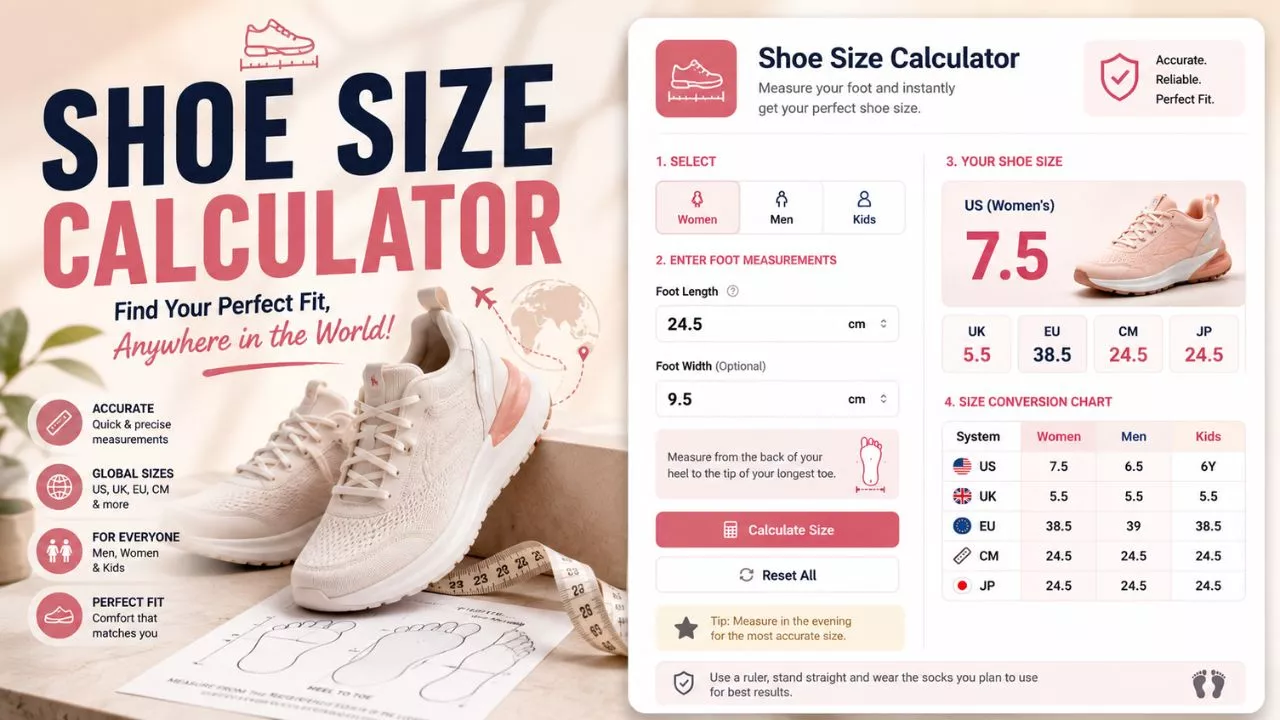
A shoe size calculator is a tool that helps you find the correct shoe size based on your foot measurements. Instead of guessing your size or relying on trial and error, this tool uses basic details like foot length, width, and sometimes even foot shape to suggest the right size. It works for different regions too, such as India, the US, the UK, and Europe, where sizing systems can vary.
Many people wear the wrong shoe size without even realizing it. This can lead to discomfort, blisters, and even long-term foot problems. A shoe size calculator removes the guesswork and gives a more accurate result. All you need is a ruler or measuring tape and a few minutes.
Some calculators are very simple and only ask for foot length, while others are more advanced and include width and arch type. Online calculators are easy to use and often provide instant results. You can also find printable charts to compare your measurements.
For example, if your foot length is 26 centimeters, a calculator might suggest a size 8 in the UK or a size 9 in the US. This saves time and helps you shop with confidence, especially when buying shoes online.
Why Getting the Right Shoe Size Matters
Wearing the correct shoe size is important for comfort, health, and daily movement. Shoes that are too tight can cause pain, blisters, and pressure on your toes. On the other hand, shoes that are too loose can make walking unstable and increase the risk of tripping or falling.
Properly fitted shoes support your feet and help maintain good posture. They also reduce stress on your ankles, knees, and back. When your shoes fit well, you can walk, run, or stand for longer periods without discomfort.
Children and teenagers need proper shoe sizes because their feet are still growing. Wearing tight shoes during this stage can affect foot development. Adults also benefit from accurate sizing, especially if they spend long hours standing or walking.
Athletes and people who play sports should pay extra attention to shoe size. A good fit improves performance and reduces the chance of injury. For example, running shoes that are too small can cause toe injuries, while oversized shoes can lead to slipping.
Using a shoe size calculator helps avoid these issues. It ensures that you get a size that matches your foot measurements instead of relying on assumptions or outdated size labels.
How to Measure Your Foot at Home
Measuring your foot at home is easy and only requires a few simple items. You will need a piece of paper, a pen or pencil, and a ruler or measuring tape. It is best to measure your feet in the evening because feet tend to swell slightly during the day.
Start by placing the paper on a flat surface and standing on it with your full weight. Make sure your heel is against a wall. Trace the outline of your foot carefully. Then, use a ruler to measure the distance from the heel to the longest toe. This is your foot length.
Next, measure the width of your foot by finding the widest part of the outline. This step is important because some people have narrow or wide feet, which can affect shoe comfort.
Repeat the process for both feet because one foot may be slightly larger than the other. Always use the measurement of the larger foot when choosing your shoe size.
For example, if one foot measures 25.8 centimeters and the other measures 26.2 centimeters, use 26.2 centimeters as your reference. Enter this value into a shoe size calculator to get your accurate size.
Understanding Different Shoe Size Systems
Shoe sizes are not the same across all countries. Different regions use different sizing systems, which can be confusing when buying shoes online or from international brands.
The most common systems are US, UK, European, and Indian sizes. Although Indian sizes often follow the UK system, there can still be slight differences depending on the brand.
For instance, a UK size 7 is not the same as a US size 7. In most cases, a US size is one number higher than the UK size for men. So, a UK size 7 is usually a US size 8. European sizes use a completely different scale based on centimeters.
A shoe size calculator helps convert your size between these systems. Instead of guessing, you can enter your foot length and get equivalent sizes for multiple regions.
This is especially useful when shopping online from global websites. You can avoid ordering the wrong size and going through the hassle of returns or exchanges.
Understanding these systems also helps when traveling or buying shoes from international stores. With the right size information, you can make confident choices without confusion.
The Role of Foot Width and Shape
Foot length is not the only factor in finding the perfect shoe size. Foot width and shape also play a big role in comfort and fit. Some people have narrow feet, while others have wide or extra wide feet.
Shoe size calculators sometimes include width options such as narrow, regular, and wide. Choosing the correct width ensures that your shoes do not feel too tight or too loose on the sides.
Foot shape is another important factor. Some people have flat feet, while others have high arches. These differences affect how weight is distributed across the foot. Shoes that do not match your foot shape can cause discomfort or pain over time.
For example, someone with wide feet may feel uncomfortable in standard shoes even if the length is correct. In such cases, selecting a wide-fit option can make a big difference.
Some calculators and tools allow you to input additional details like arch type or foot profile. These advanced features provide more accurate recommendations.
By considering both width and shape, you can find shoes that not only fit well but also support your feet properly.
Benefits of Using an Online Shoe Size Calculator
Online shoe size calculators are convenient and easy to use. They save time and help you avoid the trial-and-error process of trying different sizes.
One of the biggest advantages is accuracy. Instead of relying on general size charts, calculators use your exact measurements to give a more precise result. This reduces the chances of buying shoes that do not fit.
Another benefit is accessibility. You can use these tools anytime and from anywhere. Whether you are shopping online or checking your size before visiting a store, the calculator is always available.
Many calculators also provide size conversions for different countries. This is useful when buying shoes from international brands or websites.
For example, if you enter your foot length and get a UK size 6, the calculator may also show that it corresponds to a US size 7 and a European size 40. This makes shopping much easier.
Some advanced calculators even suggest the best shoe type based on your foot shape and activity, such as running or walking.
Common Mistakes to Avoid When Choosing Shoe Size
Many people make simple mistakes when choosing their shoe size, which can lead to discomfort and poor fit. One common mistake is relying on old size information. Foot size can change over time due to age, weight changes, or other factors.
Another mistake is ignoring foot width. Even if the length is correct, the wrong width can make shoes uncomfortable. Always consider both measurements for a better fit.
Trying shoes only while sitting is also a mistake. Your feet spread out when you stand or walk, so it is important to check the fit while standing.
Some people choose tight shoes thinking they will stretch over time. While some materials may stretch slightly, this is not guaranteed and can lead to pain.
Ignoring brand differences is another issue. Different brands may have slightly different sizing standards. Always check the size guide or use a calculator before buying.
Lastly, not measuring both feet can lead to incorrect sizing. Since one foot is often larger, using the smaller measurement can result in a poor fit.
Avoiding these mistakes can help you find shoes that are comfortable and suitable for everyday use.
Tips for Finding the Perfect Shoe Fit
Finding the perfect shoe fit involves more than just knowing your size. It requires attention to detail and a few smart choices.
Always measure your feet before buying new shoes, especially if it has been a long time since your last measurement. Use a reliable shoe size calculator to get accurate results.
Try shoes at the end of the day when your feet are slightly larger. This helps ensure that the shoes will remain comfortable throughout the day.
Wear the type of socks you plan to use with the shoes when trying them on. Thick socks can affect how the shoes fit.
Check for enough space in the toe area. There should be a small gap between your longest toe and the front of the shoe. This prevents pressure and allows natural movement.
Walk around in the shoes to test comfort and support. Pay attention to how they feel on your heels and arches.
For example, if you are buying running shoes, make sure they provide proper cushioning and do not feel tight around the toes.
By following these tips and using a shoe size calculator, you can find shoes that fit well, feel comfortable, and support your daily activities.